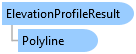
ElevationProfileResult Class
In This Topic
Defines the result of calling Map.GetElevationProfileFromSurface().
Object Model
Syntax
Public Class ElevationProfileResult
public class ElevationProfileResult
Example
Get Elevation profile from the default ground surface
{
    // get the elevation profile for a polyline / set of polylines
    Polyline polyline = PolylineBuilderEx.CreatePolyline();
    MapPoint mapPoint = MapPointBuilderEx.CreateMapPoint(34, -118, SpatialReferences.WGS84);
    List<MapPoint> mapPoints = new List<MapPoint> { mapPoint };
    var result = await MapView.Active.Map.GetElevationProfileFromSurfaceAsync([polyline]);
    if (result.Status == SurfaceZsResultStatus.Ok)
    {
        var polylineZ = result.Polyline;

        // process the polylineZ

        // get the elevation profile for a set of points
        result = await MapView.Active.Map.GetElevationProfileFromSurfaceAsync(mapPoints);
        if (result.Status == SurfaceZsResultStatus.Ok)
        {
            polylineZ = result.Polyline;
            // process the polylineZ
        }
    }
}
Get Elevation profile from a specific surface
{
    // find a specific elevation surface layer
    var eleLayer = MapView.Active.Map.GetElevationSurfaceLayers().FirstOrDefault(l => l.Name == "TIN");
    Polyline polyline = PolylineBuilderEx.CreatePolyline();
    MapPoint mapPoint = MapPointBuilderEx.CreateMapPoint(34, -118, SpatialReferences.WGS84);
    List<MapPoint> mapPoints = new List<MapPoint> { mapPoint };
    // get the elevation profile for a polyline / set of polylines
    // use the specific elevation surface layer
    var zResult = await MapView.Active.Map.GetElevationProfileFromSurfaceAsync([polyline], eleLayer);
    if (zResult.Status == SurfaceZsResultStatus.Ok)
    {
        var polylineZ = zResult.Polyline;

        // process the polylineZ
    }

    // get the elevation profile for a set of points
    // use the specific elevation surface layer
    zResult = await MapView.Active.Map.GetElevationProfileFromSurfaceAsync(mapPoints, eleLayer);
    if (zResult.Status == SurfaceZsResultStatus.Ok)
    {
        var polylineZ = zResult.Polyline;

        // process the polylineZ
    }
}
Interpolate a line between two points and calculate the elevation profile
{
    int numPoints = 20;//Or any number of points you want to interpolate
                       // use a specific elevation surface
    var eleLayer = MapView.Active.Map.GetElevationSurfaceLayers().FirstOrDefault(l => l.Name == "TIN");
    // use the default ground elevation surface
    MapPoint startPt = MapPointBuilderEx.CreateMapPoint(-130, 20, SpatialReferences.WGS84);

    MapPoint endPt = MapPointBuilderEx.CreateMapPoint(-100, 50, SpatialReferences.WGS84);
    var result = await MapView.Active.Map.GetElevationProfileFromSurfaceAsync(startPt, endPt, numPoints);
    if (result.Status == SurfaceZsResultStatus.Ok)
    {
        var polylineZ = result.Polyline;

        // process the polylineZ
    }
    // use a specific elevation surface
    result = await MapView.Active.Map.GetElevationProfileFromSurfaceAsync(startPt, endPt, numPoints, eleLayer);
    if (result.Status == SurfaceZsResultStatus.Ok)
    {
        var polylineZ = result.Polyline;

        // process the polylineZ
    }
}
Show Elevation profile graph using an ElevationProfileResult
{
    MapPoint startPt = MapPointBuilderEx.CreateMapPoint(-130, 20, SpatialReferences.WGS84);
    MapPoint endPt = MapPointBuilderEx.CreateMapPoint(-100, 50, SpatialReferences.WGS84);
    var elevProfileResult = await MapView.Active.Map.GetElevationProfileFromSurfaceAsync(startPt, endPt, 10);
    if (elevProfileResult.Status != SurfaceZsResultStatus.Ok)
        return;

    if (!MapView.Active.CanShowElevationProfileGraph())
        return;

    // show the elevation profile using the result
    MapView.Active.ShowElevationProfileGraph(elevProfileResult);
}
Inheritance Hierarchy
System.Object
ArcGIS.Desktop.Mapping.ElevationProfileResult
Requirements
Target Platforms: Windows 11 Home, Pro, Enterprise (64 bit)
ArcGIS Pro version: 3.4 or higher.
See Also