Routes
 Available with the Linear Referencing license.
Routes are z- and m-enabled polyline features that store measure values on their vertices to model the distance along a line. Routes store measure values on vertices because, in many cases, the geometry of a feature is not as accurate as the measured lengths maintained for the feature. This can be the case for roads, pipes, railways, and other linear features. The routes maintain measures to support locating linear-referenced events.
In a linear referencing system (LRS), the LRS editor associates centerline features and provides measure inputs using tools to create or modify routes. The tools to create or modify route features also calculate and store the measure values on the route’s vertices. The tools in the centerline sequence table manage centerlines in a separate polyline feature class and associate them with routes.
The centerline sequence table allows the same centerlines to be associated with different routes in the same LRS Network (as is the case with concurrent routes) or with routes in different LRS Networks. This allows the same polyline geometry (centerline) to be used to create different measure systems (route features). Examples of measure systems include continuous, engineering stationing, state mile point, and county mile point, all of which can be built on the same centerlines.
Only LRS editors need to work with centerline features to build and edit routes. Locating linear-referenced events on routes or measure or spatial analysis on routes does not require centerlines. In addition, LRS editors need not work with the centerline sequence table explicitly. The tools implicitly populate this table.
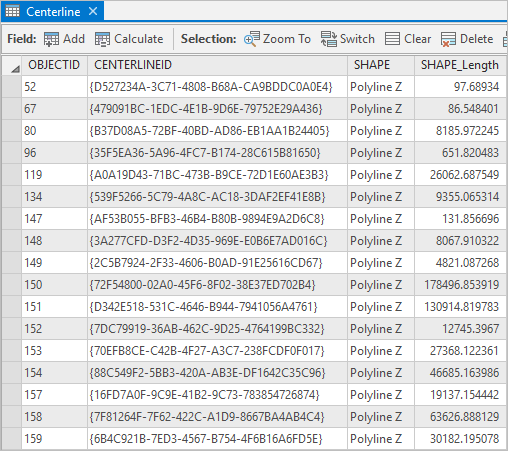
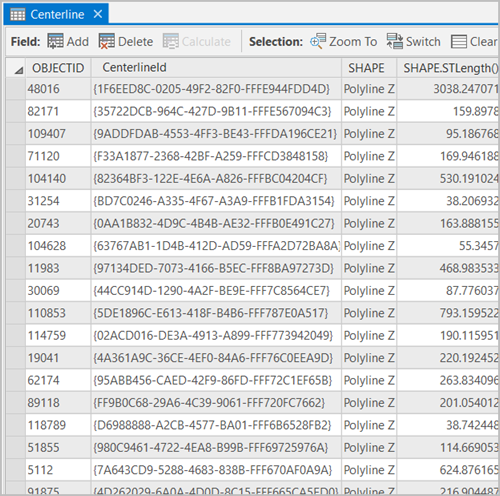
Centerline feature class
The centerline feature class is the geometry source from which routes are created. The table must have an ObjectID field and a centerline ID field. The centerline ID field is a system-generated GUID that associates centerlines to routes. You can give the centerline feature class a name appropriate to your organization, but you can have only one centerline feature class per LRS.
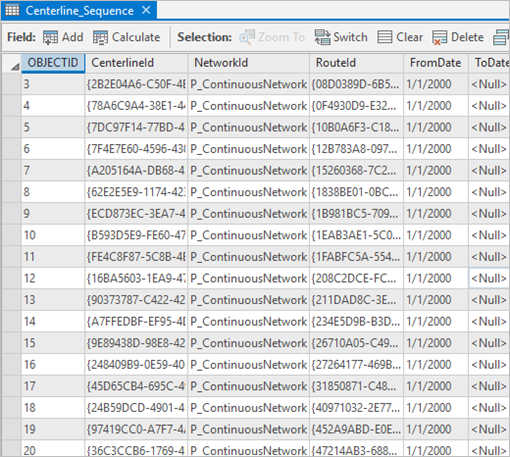
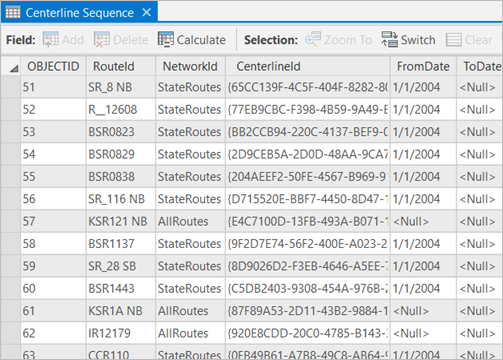
Centerline sequence table
The centerline sequence table is a cross-reference table for the many-to-many relationships between centerlines and routes. The table must include a centerline ID field, a route ID field, a network ID field, and start and end date fields.