VfSec
Summary
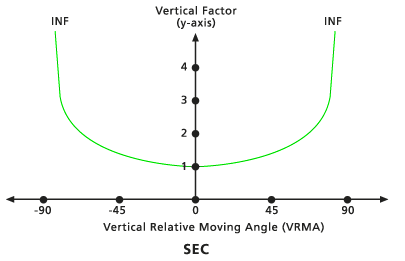
Defines the relationship between the vertical cost factor and the vertical relative moving angle through a secant function.
Discussion
This object is used in the Distance Accumulation and Distance Allocation Spatial Analyst tools, as well as the Path Distance, Path Distance Allocation, and Path Distance Back Link Legacy Distance tools.
The vertical factor (VF) object defines the relationship between the vertical cost factor and the vertical relative moving angle (VRMA).
VF defines the vertical difficulty encountered in moving from one cell to the next.
VRMA identifies the slope angle between the FROM or processing cell and the TO cell.
The VF is determined by the secant function of the VRMA.
Syntax
VfSec({lowCutAngle}, {highCutAngle}, {secPower})
| Name | Explanation | Data type |
|---|---|---|
|
lowCutAngle (Optional) |
The VRMA degree defining the lower threshold, below which (less than) the VFs are set to infinity. The default value is -90.0. |
Double |
|
highCutAngle (Optional) |
The VRMA degree defining the upper threshold, beyond which (larger than) the VFs are set to infinity. The default value is 90.0. |
Double |
|
secPower (Optional) |
The power to which the values in the secant VRMA function will be raised. The VF is determined by: \(VF = \sec(VRMA)^{Power}\) The default value is 1.0. |
Double |
Properties
| Name | Explanation | Data type |
|---|---|---|
|
lowCutAngle (Read and Write) |
The VRMA degree defining the lower threshold, below which (less than) the VFs are set to infinity. |
Double |
|
highCutAngle (Read and Write) |
The VRMA degree defining the upper threshold, beyond which (larger than) the VFs are set to infinity. |
Double |
|
secPower (Read and Write) |
The power to which the values in the secant VRMA function will be raised. |
Double |
Code sample
Demonstrates how to create a VfSec class and use it in the DistanceAccumulation tool within the Python window.
import arcpy
from arcpy import env
from arcpy.sa import *
env.workspace = "C:/sapyexamples/data"
myVerticalFactor = VfSec(-90, 90, 1)
outDistAccum = DistanceAccumulation("Source.shp", "", "elev.tif",
                                   "cost.tif", "elev.tif",
                                    myVerticalFactor)
outDistAccum.save("C:/sapyexamples/output/distAccumVfS.tif")
Performs a distance accumulation analysis using the VfSec class.
# Name: VfSec_Ex_02.py
# Description: Uses the VfSec object to run the
#              DistanceAccumulation tool
# Requirements: Spatial Analyst extension

# Import system modules
import arcpy
from arcpy import env
from arcpy.sa import *

# Set environment settings
env.workspace = "C:/sapyexamples/data"

# Set local variables
inSourceData = "source.shp"
inCostRaster = "costraster.tif"
inElevation = "elev.tif"

# Create the VfSec Object
lowCutAngle = -90
highCutAngle = 90
secPower = 1
myVerticalFactor = VfSec(lowCutAngle, highCutAngle, secPower)

# Run PathDistance
outDistAccum = DistanceAccumulation(inSourceData, "", inElevation,
                                    inCostRaster, inElevation,
                                    myVerticalFactor)

# Save the output
outDistAccum.save("C:/sapyexamples/output/distaccumvfS2.tif")