VfSymLinear
Summary
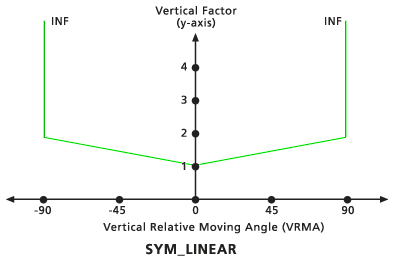
Defines the relationship between the vertical cost factor and the vertical relative moving angle (VRMA) through a symmetrical linear function in either the negative or positive side of the VRMA, respectively. The two linear functions are symmetrical with respect to the VF (y) axis.
Discussion
This object is used in the Distance Accumulation and Distance Allocation Spatial Analyst tools, as well as the Path Distance, Path Distance Allocation, and Path Distance Back Link Legacy Distance tools.
The vertical factor (VF) object defines the relationship between the vertical cost factor and the vertical relative moving angle (VRMA).
VF defines the vertical difficulty encountered in moving from one cell to the next.
VRMA identifies the slope angle between the FROM or processing cell and the TO cell.
The VfSymLinear class is composed of two linear functions relative to the VRMAs that are symmetrical to the VF (y) axis. Both lines intercept the y-axis at the VF value associated with the zeroFactor. The slope of the lines is defined as a single slope relative to the positive VRMA using the slope vertical factor argument, which is mirrored to the negative VRMAs.
Syntax
VfSymLinear({zeroFactor}, {lowCutAngle}, {highCutAngle}, {slope})
| Name | Explanation | Data type |
|---|---|---|
|
zeroFactor (Optional) |
The The default value is 1.0. |
Double |
|
lowCutAngle (Optional) |
The VRMA degree defining the lower threshold, below which (less than) the VFs are set to infinity. The default value is -90.0. |
Double |
|
highCutAngle (Optional) |
The VRMA degree defining the upper threshold, beyond which (larger than) the VFs are set to infinity. The default value is 90.0. |
Double |
|
slope (Optional) |
Identifies the slope of the straight line in the VRMA-VF coordinate system. Slope is specified as the rise/run. For example, a 30-degree slope is 1/30, specified as 0.03333 (rise/run: 1 VF on the y axis / 30 degrees on the x axis); a 90-degree slope as 0.011111. The default value is 0.011111. |
Double |
Properties
| Name | Explanation | Data type |
|---|---|---|
|
zeroFactor (Read and Write) |
The |
Double |
|
lowCutAngle (Read and Write) |
The VRMA degree defining the lower threshold, below which (less than) the VFs are set to infinity. |
Double |
|
highCutAngle (Read and Write) |
The VRMA degree defining the upper threshold, beyond which (larger than) the VFs are set to infinity. |
Double |
|
slope (Read and Write) |
Identifies the slope of the straight line in the VRMA-VF coordinate system. Slope is specified as the rise over the run. For example, a 30-degree slope is 1/30, specified as 0.03333 (rise/run: 1 VF on the y axis / 30 degrees on the x axis); a 90-degree slope as 0.011111. |
Double |
Code sample
Demonstrates how to create a VfSymLinear class and use it in the DistanceAccumulation tool within the Python window.
import arcpy
from arcpy import env
from arcpy.sa import *
env.workspace = "C:/sapyexamples/data"
myVerticalFactor = VfSymLinear(1.0, -90, 90, -0.01111)
outDistAccum = DistanceAccumulation("Source.shp", "", "elev.tif",
                                   "cost.tif", "elev.tif",
                                    myVerticalFactor)
outDistAccum.save("C:/sapyexamples/output/distAccumVfSL.tif")
Performs a distance accumulation analysis using the VfSymLinear class.
# Name: VfSymLinear_Ex_02.py
# Description: Uses the VfSymLinear object to run the
#              DistanceAccumulation tool
# Requirements: Spatial Analyst extension

# Import system modules
import arcpy
from arcpy import env
from arcpy.sa import *

# Set environment settings
env.workspace = "C:/sapyexamples/data"

# Set local variables
inSourceData = "source.shp"
inCostRaster = "costraster.tif"
inElevation = "elev.tif"

# Create the VfSymLinear Object
zeroFactor = 1.0
lowCutAngle = -90
highCutAngle = 90
slope = -0.01111
myVerticalFactor = VfSymLinear(zeroFactor, lowCutAngle, highCutAngle, slope)

# Run PathDistance
outDistAccum = DistanceAccumulation(inSourceData, "", inElevation,
                                    inCostRaster, inElevation,
                                    myVerticalFactor)

# Save the output
outDistAccum.save("C:/sapyexamples/output/distaccumvfSL2.tif")