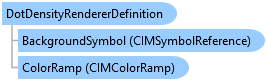
DotDensityRendererDefinition Class
In This Topic
Represents a dot density symbol renderer definition to show quantitative values for a
field as a series of pattern fills based on the field value for each polygon.
Object Model
Syntax
Public Class DotDensityRendererDefinition
   Inherits RendererDefinition
public class DotDensityRendererDefinition : RendererDefinition
Remarks
With dot density symbology, the data you symbolize is not classified.
Instead, quantitative values for one or more fields are represented as a
collection of point symbols (typically solid circles or dots) within each polygon.
Each dot represents a constant number of things, or people, or other quantifiable phenomena.
The dots are equally sized, even when multiple fields are symbolized together within a layer.
Example
Dot Density renderer.
/// <summary> /// Renders a polygon feature layer with Dot Density symbols to represent quantities. /// 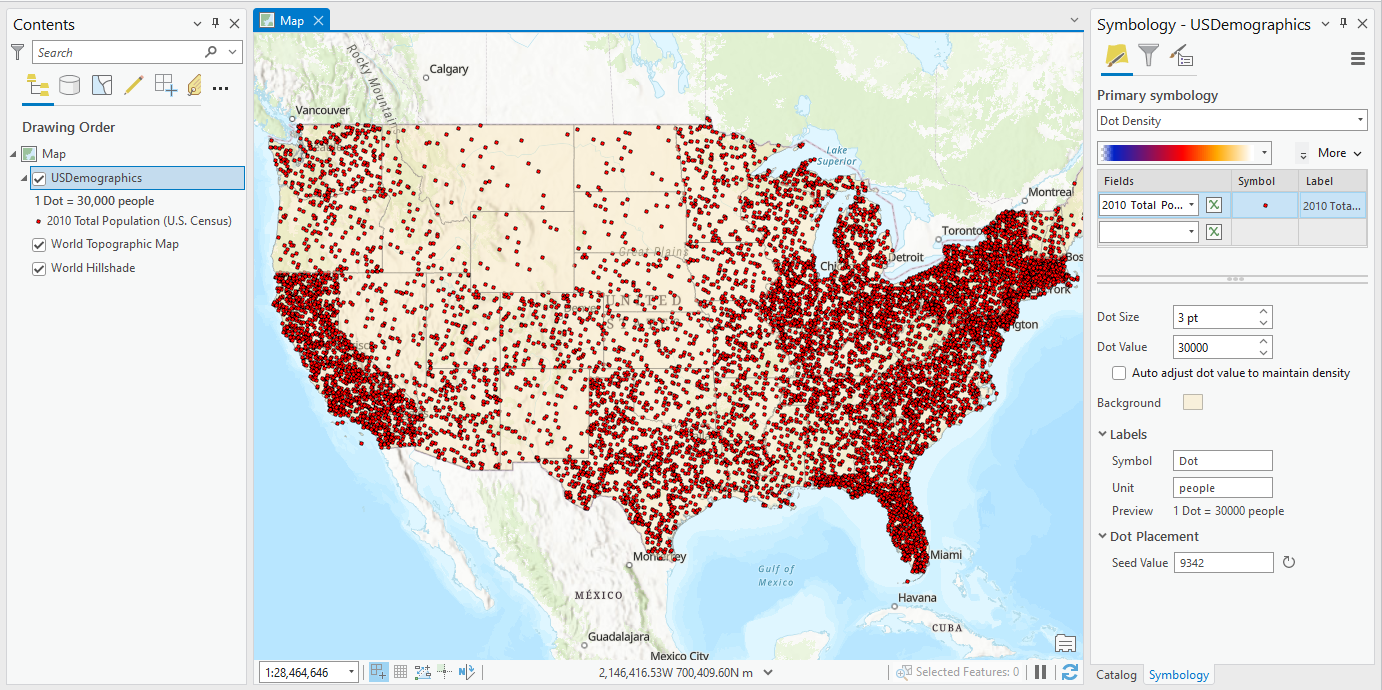 /// </summary> { //Check feature layer name //Code works with the USDemographics feature layer available with the ArcGIS Pro SDK Sample data var featureLayer = MapView.Active.Map.GetLayersAsFlattenedList().OfType<FeatureLayer>().FirstOrDefault(f => f.Name == "USDemographics"); if (featureLayer == null) { MessageBox.Show("This renderer works with the USDemographics feature layer available with the ArcGIS Pro SDK Sample data", "Data missing"); } //Define size of the dot to use for the renderer int dotSize = 3; //Check if the TOTPOP10 field exists int idxField = -1; using (var table = featureLayer.GetTable()) { var def = table.GetDefinition(); idxField = def.FindField("TOTPOP10"); } // "TOTPOP10" field was not found if (idxField == -1) return; //array of fields to be represented in the renderer var valueFields = new List<string> { "TOTPOP10" }; //Note: Run within QueuedTask //Create the DotDensityRendererDefinition object var dotDensityDef = new DotDensityRendererDefinition(valueFields, colorRamp, dotSize, 30000, "Dot", "people"); //Create the renderer using the DotDensityRendererDefinition CIMDotDensityRenderer dotDensityRndr = (CIMDotDensityRenderer)featureLayer.CreateRenderer(dotDensityDef); //if you want to customize the dot symbol for the renderer, create a "DotDensitySymbol" which is an //Amalgamation of 3 symbol layers: CIMVectorMarker, CIMSolidFill and CIMSolidStroke //Define CIMVectorMarker layer var cimMarker = SymbolFactory.Instance.ConstructMarker(ColorFactory.Instance.RedRGB, dotSize); var dotDensityMarker = cimMarker as CIMVectorMarker; //Define the placement CIMMarkerPlacementInsidePolygon markerPlacement = new CIMMarkerPlacementInsidePolygon { Randomness = 100, GridType = PlacementGridType.RandomFixedQuantity, Clipping = PlacementClip.RemoveIfCenterOutsideBoundary }; dotDensityMarker.MarkerPlacement = markerPlacement; //Define CIMSolidFill layer CIMSolidFill solidFill = new CIMSolidFill { Color = new CIMRGBColor { R = 249, G = 232, B = 189, Alpha = 50 } }; //Define CIMSolidStroke CIMSolidStroke solidStroke = new CIMSolidStroke { Color = ColorFactory.Instance.GreyRGB, Width = .5 }; //Create the amalgamated CIMPolygonSymbol that includes the 3 layers var dotDensitySymbol = new CIMPolygonSymbol { SymbolLayers = new CIMSymbolLayer[] { dotDensityMarker, solidFill, solidStroke } }; //Apply the dotDensitySymbol to the CIMDotDenstityRenderer's DotDensitySymbol property. dotDensityRndr.DotDensitySymbol = dotDensitySymbol.MakeSymbolReference(); //Apply the renderer to the polygon Feature Layer. featureLayer.SetRenderer(dotDensityRndr); }
Inheritance Hierarchy
System.Object
ArcGIS.Desktop.Mapping.LayerDrawingDefinition
ArcGIS.Desktop.Mapping.RendererDefinition
ArcGIS.Desktop.Mapping.DotDensityRendererDefinition
Requirements
Target Platforms: Windows 11 Home, Pro, Enterprise (64 bit)
ArcGIS Pro version: 3.0 or higher.
See Also