Bitwise Or (Image Analyst Tools)
Summary
Performs a Bitwise Or operation on the binary values of two input rasters.
Illustration
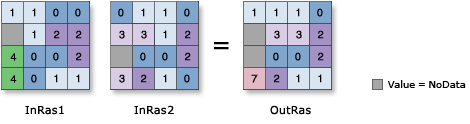
Usage
Two inputs are necessary for this bitwise operation to take place.
The order of inputs is irrelevant for this tool.
If an input is floating point, the values are converted to integer values through truncation before the bitwise operation is performed.
In bitwise operations, the following are true:
Binary values are stored in two's complement.
The tools work on 32-bit integers.
The leftmost bit position is reserved for the sign (positive or negative) of the value. If the integer is positive, the bit position is 0; if it's negative, the bit position is 1.
The Bitwise Or operation treats the sign bit as it would any other bit. If one or both inputs for a cell location are negative, the output is negative; if both inputs are positive, the output is positive.
If both inputs are single-band rasters or one of the inputs is a constant, the output will be a single-band raster.
If both inputs are multiband rasters, the tool will perform the operation on each band from one input, and the output will be a multiband raster. The number of bands in each multiband input must be the same.
If one of the inputs is a multiband raster and the other input is a constant, the tool will perform the operation using the constant value for each band in the multiband input, and the output will be a multiband raster.
If both inputs are multidimensional raster data with the same number of variables, the tool will perform the operation for all slices with the same dimension value. The output will be a multidimensional raster in CRF format. The variables in the inputs must have at least one common dimension and one common dimensional value for this tool to process; otherwise, an error will occur.
If both inputs have one variable but different names, uncheck the Match Multidimensional Variable geoprocessing environment (set
arcpy.env.matchMultidimensionalVariable = Falsein Python) before running the tool.If one of the inputs is a multidimensional raster and the other input is a constant, the tool will perform the operation for all slices for all variables using the constant value, and the output will be a multidimensional raster.
Parameters
| Label | Explanation | Data type |
|---|---|---|
|
Input raster or constant value 1 |
The first input to use in this bitwise operation. A number can be used as an input for this parameter, provided a raster is specified for the other parameter. To specify a number for both inputs, the cell size and extent must first be set in the environment. |
Raster Layer; Constant |
|
Input raster or constant value 2 |
The second input to use in this bitwise operation. A number can be used as an input for this parameter, provided a raster is specified for the other parameter. To specify a number for both inputs, the cell size and extent must first be set in the environment. |
Raster Layer; Constant |
Return value
| Label | Explanation | Data type |
|---|---|---|
|
Output raster |
The output raster. The cell values are the result of a Bitwise Or operation on the two inputs. |
Raster |
Environments
Auto Commit, Cell Size, Cell Size Projection Method, Compression, Current Workspace, Extent, Geographic Transformations, Mask, Output CONFIG Keyword, Output Coordinate System, Scratch Workspace, Snap Raster, Tile Size
Licensing information
- Basic: Requires Image Analyst or Spatial Analyst
- Standard: Requires Image Analyst or Spatial Analyst
- Advanced: Requires Image Analyst or Spatial Analyst