Best practices for ArcGIS Reality Server sites
Note:
ArcGIS Reality Server is a beta feature at ArcGIS Enterprise 12.1. While in beta, this capability may not be feature complete and, as such, may have known performance or quality issues and will not be supported by Esri Technical Support.
Feedback on this feature can be provided in the ArcGIS Enterprise 12.1 Beta Features Early Adopter Community.
ArcGIS Reality Server is designed to support scaling of your Reality mapping workflows to create accurate and realistic photogrammetric products from large collections of drone, aerial, and satellite imagery. This scalability is made possible by its underlying distributed computing framework. This framework is unique in that it can use resources on a single machine or distribute the computing process across a multiple-machine site.
Components needed to use ArcGIS Reality Server
ArcGIS Reality Server is a capability of ArcGIS Enterprise that is enabled by licensing ArcGIS Server for Reality Server. A typical deployment of Reality Server is composed of three server sites: a portal's hosting server site (in the base ArcGIS Enterprise deployment), an image hosting site, and a multiple-machine Reality Server site. This configuration maximizes efficiency and productivity. Although image hosting server and reality server functionality can be combined and hosted on one server, separating distributed reality server and image service hosting roles allows resources to be dedicated to specific tasks without interruption. In this way, multiple users requesting access to various raster products and services do not compete for and impact image processing resources.
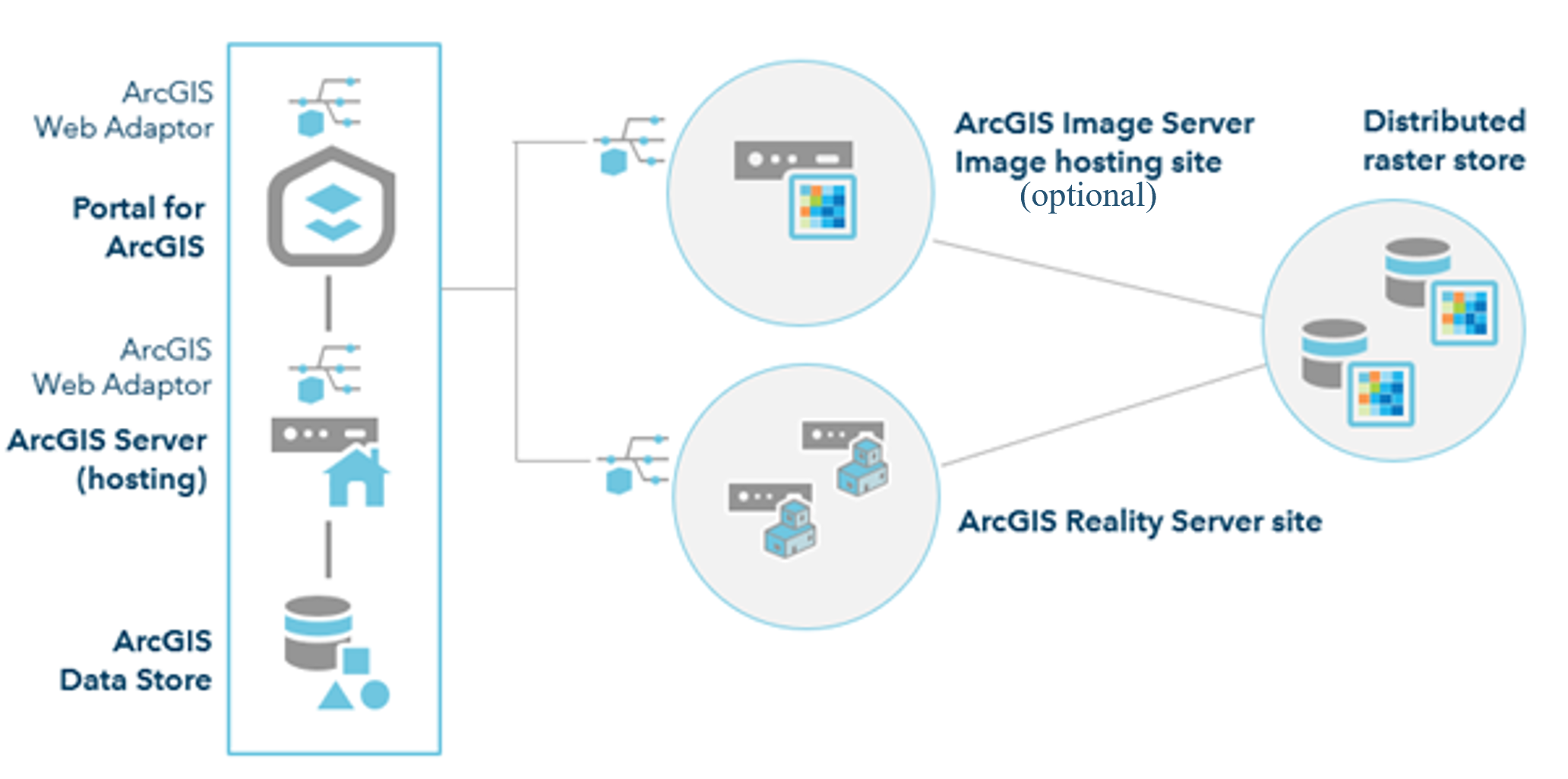
ArcGIS Enterprise deployment
ArcGIS Reality Server requires an ArcGIS Enterprise base deployment, which provides software and user interfaces to organize and manage processing, storage, and sharing of raster and feature data, maps, and other geographic information on a variety of devices. The process of installing and configuring an ArcGIS Enterprise base deployment can be done manually or automatically with the use of ArcGIS Enterprise Builder.
The provided templates allow you to deploy ArcGIS Enterprise in the cloud. These templates set up ArcGIS Enterprise in a configuration of your choice.
For a single-machine deployment, use the CloudFormation templates on Amazon Web Services.
For a multiple-machine deployment, use the following templates:
Multiple-machine deployment on-premises—See the highly available system configuration template.
Provision a highly available ArcGIS Enterprise deployment on Amazon Web Services.
ArcGIS Image Server
The site requires the following components:
An ArcGIS Server site licensed for ArcGIS Image Server
An installation of ArcGIS Web Adaptor configured with the site licensed for image hosting
Important:
A separate image hosting site is not required but is recommended for better performance and resource allocation.
ArcGIS Reality Server
The site requires the following components:
- An ArcGIS Server site licensed and configured for ArcGIS Reality Server and ArcGIS Server. Reality Server license includes the "image basic" license that allows creation/sharing of image services.
Important:
A Reality Server site must have server advance license + Reality Server license to be fully functional.
- An installation of ArcGIS Web Adaptor configured with the site licensed for Reality Server
System architecture and requirements
The following are the minimum hardware requirements for each machine of the three server sites and also the ArcGIS Enterprise components assigned to each one:
Hosting server (1 machine)
Software components–ArcGIS Portal, ArcGIS Data Store (relational database and managed object store), and ArcGIS Server
Recommended hardware:
- RAM–64 GB minimum
Image hosting (1 machine)
Software components–ArcGIS Server and Image Server Extension
Recommended hardware:
- RAM–32 GB minimum
Reality server (1 machine minimum)
Software components–ArcGIS Server and Reality Server Extension
Recommended hardware:
Virtual/logical core count–24 minimum
RAM–64 GB minimum
Storage–1 TB minimum