
汇总统计数据 (分析工具)

汇总

为表中字段计算汇总统计数据。

插图
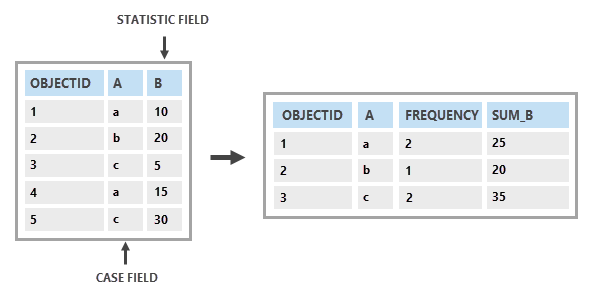
汇总统计数据工具图示

用法

  • 输出将由包含统计运算结果的字段组成。

  • 使用此工具可执行以下统计运算:总和、平均值、最小值、最大值、范围、标准差、计数、第一个、最后一个、中值、方差、唯一值、串连和众数。

  • 如果指定案例分组字段参数,则将针对每组唯一的字段值计算统计数据。 输出表将针对每组唯一的字段值包含一条记录。 如果未指定案例分组字段参数,则将计算所有输入记录的统计数据。 输出表将包含单个记录。

    输出的 Frequency 字段是唯一的一组字段值所表示的所有输入记录的计数。 如果未指定案例分组字段参数,则其将为所有输入记录的计数。

  • 将使用以下命名约定为每种统计类型创建字段:SUM_<field>MEAN_<field>MIN_<field>MAX_<field>RANGE_<field>STD_<field>COUNT_<field>FIRST_<field>LAST_<field>MEDIAN_<field>VARIANCE_<field>UNIQUE_<field>CONCATENATE_<field>DBMS_SUM_<field>DBMS_MEAN_<field>DBMS_MIN_<field>DBMS_MAX_<field>DBMS_STD_<field>DBMS_COUNT_<field>DBMS_MEDIAN_<field>DBMS_VARIANCE_<field>(其中 &lt;field>\ 是计算统计数据的输入字段的名称)。 当输出表是 dBASE 表时,字段名称会被截断为 10 个字符。

  • 可以使用 DBMS 统计类型直接在数据库或服务(而非在客户端)上处理统计数据。 仅以下输入地理数据库数据源支持 DBMS 统计类型:企业级地理数据库、要素服务、云数据仓库、GeoPackage 和 SQLite 地理数据库。

    DBMS 统计类型不支持 dBASE 输出。

  • 空值将被排除在所有统计计算之外。 例如,6、4 和空值的平均值为 5 ((6+4)/2)。

  • 使用图层时,仅使用当前所选要素计算统计数据。

参数

标注 说明 数据类型

输入表

包含用于计算统计数据的字段的输入表。

Table View; Raster Layer

输出表

输出表用于存储计算的统计数据。

Table

统计字段

指定包含将用于计算指定统计数据的属性值的字段。 可以指定多项统计和字段组合。 空值将被排除在所有计算之外。

可使用任何一种统计来对数值属性字段进行汇总。 可以使用最小值、最大值、计数、第一个、最后一个、唯一值、串连和众数统计数据对文本属性字段进行汇总。 只能使用平均值、最小值、最大值、计数、第一个、最后一个、唯一值和串连统计数据对日期、仅日期和时间戳偏移属性字段进行汇总。

仅以下输入地理数据库数据源支持 DBMS 统计类型:企业级地理数据库、要素服务、云数据仓库和 SQLite 地理数据库

值表列:

  • FieldThe field containing attribute values used to calculate the specified statistic.

  • Statistic TypeThe statistic type.

    • SumThe values for the specified field will be added together.

    • MeanThe average for the specified field will be calculated.

    • MinimumThe smallest value of the specified field will be identified.

    • MaximumThe largest value of the specified field will be identified.

    • RangeThe range of values (maximum minus minimum) for the specified field will be calculated.

    • Standard deviationThe standard deviation of values for the specified field will be calculated.

    • CountThe number of values in the specified field will be identified.

    • FirstThe specified field value of the first record in the input will be used.

    • LastThe specified field value of the last record in the input will be used.

    • MedianThe median of the specified field will be calculated.

    • VarianceThe variance of the specified field will be calculated.

    • UniqueThe number of unique values of the specified field will be counted.

    • ConcatenateThe values for the specified field will be concatenated.

    • ModeThe mode (the most common value) for the specified field will be identified. If more than one value is equally common, the lowest value will be returned.

    • DBMS SumThe values for the specified field will be added together.

    • DBMS MeanThe average for the specified field will be calculated.

    • DBMS MinimumThe smallest value of the specified field will be identified.

    • DBMS MaximumThe largest value of the specified field will be identified.

    • DBMS Standard deviationThe standard deviation of values for the specified field will be calculated.

    • DBMS CountThe number of values in the specified field will be identified.

    • DBMS MedianThe median of the specified field will be calculated.

    • DBMS VarianceThe variance of the specified field will be calculated.

Value Table

案例分组字段

(可选)

“输入”中将用于为每个唯一属性值(如果指定多个字段,则为属性值组合)单独计算统计数据的一个或多个字段。

Field

串连分隔符

(可选)

串连选项用于统计字段参数时,将用于串连值的一个或多个字符。 默认情况下,该工具将连接不带分隔符的值。

String

环境

输出配置关键字, 当前工作空间, 临时工作空间, 时区

特殊情况

时区

The mean statistic type on a Timestamp offset field will use the timezone offset from this environment.

许可信息

  • 基本: 是
  • 标准: 是
  • 高级: 是