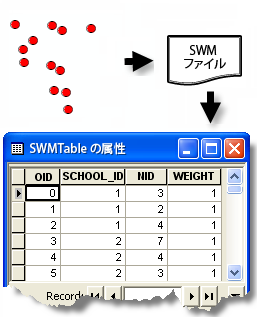
arcpy.stats.ConvertSpatialWeightsMatrixtoTable(Input_Spatial_Weights_Matrix_File, Output_Table)
|
名前
|
説明
|
データ タイプ
|
|
Input_Spatial_Weights_Matrix_File
|
変換する空間加重マトリックス ファイル (.swm) の完全パス名。
|
File
|
|
Output_Table
|
作成するテーブルの完全パス名。
|
Table
|
コードのサンプル
ConvertSpatialWeightsMatrixtoTable 例 1 (Python ウィンドウ)
次の Python ウィンドウ スクリプトは、ConvertSpatialWeightsMatrixtoTable 関数の使用方法を示しています。
import arcpy
arcpy.env.workspace = "c:/data"
arcpy.stats.ConvertSpatialWeightsMatrixtoTable(
    "euclidean6Neighs.swm", "euclidean6Neighs.dbf")
ConvertSpatialWeightsMatrixtoTable 例 2 (スタンドアロン スクリプト)
次のスタンドアロン Python スクリプトは、ConvertSpatialWeightsMatrixtoTable 関数の使用方法を示しています。
# Create a Spatial Weights Matrix based on Network Data.

# Import system modules.
import arcpy

# Set property to overwrite existing output.
arcpy.env.overwriteOutput = True

# Local variables...
workspace = r"C:\Data\USCounties\US"

# Set the current workspace (to avoid having to specify the full path to the
# feature classes each time).
arcpy.env.workspace = workspace

# Create Spatial Weights Matrix.
# Process: Generate Spatial Weights Matrix...
swm = arcpy.stats.GenerateSpatialWeightsMatrix(
    "USCounties.shp", "MYID", "euclidean6Neighs.swm", "K_NEAREST_NEIGHBORS",
    "#", "#", "#", 6)

# Dump Spatial Weights to Database Table.
# Process: Convert Spatial Weights Matrix to Table...
dbf = arcpy.stats.ConvertSpatialWeightsMatrixtoTable(
    "euclidean6Neighs.swm", "euclidean6Neighs.dbf")

# Now you can edit the spatial weights (add, subtract and alter
# neighbors and weights).

# Read weights from table back into Spatial Weights Matrix format.
# Process: Generate Spatial Weights Matrix...
swm = arcpy.stats.GenerateSpatialWeightsMatrix(
    "USCounties.shp", "MYID", "euclidean6Neighs.swm", "CONVERT_TABLE", "#",
    "#", "#", "#", "#", "#", "euclidean6Neighs.dbf")