Event editing using the attribute table
 Available with the Linear Referencing license.
You can edit an event in a feature service by updating its record in the attribute table.
You can edit the attribute table to correct errors, reflect changes to measures on an associated route, or update the value of a unique event attribute, such as direction or pressure. For example, you can make an edit to reflect a change of direction in the flow of liquid in a pipe or a change in the pressure rating in a pipe segment that occurs on a specific date.
You can edit the attribute table to correct errors, reflect changes to measures on an associated route, or update the value of a unique event attribute, such as a change in roadway type or a change in speed limit that occurs on a specific date.
After you edit an attribute table row, the system-provided Location Error value updates to indicate the status.
Before editing a feature service, you must share branch versioned linear referencing system (LRS) data as a web layer. If the feature service is not yet published, see Share as web layers.
Tip:
Right-click the event layer to which you want to add an event, and choose Attribute Table to open its attribute table. To edit an event record, click in its row and update the values for the event.
If a message regarding acquiring locks or reconciling appears, it means that conflict prevention is enabled.
After editing an event’s vertices, you can retire the existing event and create a new event with a start date as of the specified retirement date including the edited vertices. You can also merge any coincident line events. For more information, refer to the event editing options in the Linear Referencing options.
Events that have stationing and referents configured are supported in ArcGIS Pro. When editing a referent or stationing event in the attribute table, you can provide the values for the stationing or referent columns; however, the event is drawn based only on the values provided in the measure fields.
Location errors
The location error attributes provide information about the status of each event feature. When you edit an event feature correctly, the location error field of the event displays the No Error value.
Note:
You can also review a complete list of location errors.
Any of the following statuses indicate a problem that should be resolved:
| Location error | Description |
|---|---|
| Different From Route And To Route Line IDs | The starting route and the ending route have different line IDs. This is applicable to events associated with line networks. |
| Invalid Dates | The event's end date is before the event's start date. When you edit an event's start date to be after its end date using the attribute table, they are automatically swapped. |
| Invalid Route Line ID | The route's line ID is invalid. This is applicable to events associated with line networks. |
| Invalid Route Line Order | The route's line order is invalid. This is applicable to events associated with line networks. |
| Invalid Location Route ID | The route location's route ID is invalid (NULL, empty, or invalid value). |
| Invalid Location Measure | At least one of the route location's measure values is invalid. |
| Invalid Route ID | The route location's route ID is invalid (NULL, empty, or invalid value). |
| Measure Extent Out Of Route Measure Range | The route location's shape doesn't exist on the route. The route has no m-values, or the route location's measures don't exist on the route. |
| Multiple Route Locations Found | More than one point location was found. Measures may not be unique along the routes. |
| Null Extent | The start measure is equal to the end measure. |
| Parent Event Not Found | The route location's shape was not found because the start measure and the end measure are outside the route measures. |
| Partial Match For The From Measure and To Measure | The start measure and the end measure are outside the route measure range. |
| Partial Match For The From Measure | The start measure is outside the route measure range. |
| Partial Match For The To Measure | The end measure is outside the route measure range. |
| Reversed Line Order | The starting route does not have a lower line order than the ending route. This is applicable to events associated with line networks. |
| Route Measures Null | The route does not have m-values, or the m-values are null. |
| Route Not Found | The route does not exist in the time slice in which the event is active. |
| Route Shape Empty | The route does not have a shape, or the shape is empty. |
| Route Not M Aware | The route is not an m-aware line. |
Scenarios for editing line events using the attribute table
The scenarios below detail the results of editing nonspanning event values in the event layer's attribute table.
Event measure editing
The following diagram shows the route and its associated event before the edit:

The following table details the route attributes. Valid measures for an event on Route 1 must be between 0 and 20, and valid dates must fall on or after 1/1/2000.
| Route ID | From Date | To Date |
|---|---|---|
| Route1 | 1/1/2000 | <Null> |
The following table details the event before editing using the attribute table:
| Event ID | Route ID | From Date | To Date | From Measure | To Measure | Location Error | MAOP Design |
|---|---|---|---|---|---|---|---|
| Event1 | Route1 | 1/1/2005 | <Null> | 10 | 20 | No Error | 800 |
| Event ID | Route ID | From Date | To Date | From Measure | To Measure | Location Error | Speed Limit |
|---|---|---|---|---|---|---|---|
| Event1 | Route1 | 1/1/2005 | <Null> | 10 | 20 | No Error | 55 |
The following diagram shows changing the starting measure of the event:
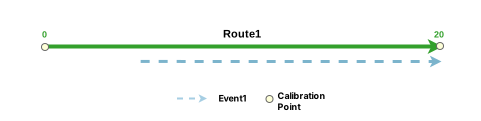
The following table details the event after the measure has changed from 10 to 5, which causes a change in its shape:
| Event ID | Route ID | From Date | To Date | From Measure | To Measure | Location Error | MAOP Design |
|---|---|---|---|---|---|---|---|
| Event1 | Route1 | 1/1/2005 | <Null> | 5 | 20 | No Error | 800 |
| Event ID | Route ID | From Date | To Date | From Measure | To Measure | Location Error | Speed Limit |
|---|---|---|---|---|---|---|---|
| Event1 | Route1 | 1/1/2005 | <Null> | 5 | 20 | No Error | 55 |
Event measure editing resulting in a location error
The following diagram shows the route and its associated event before the edit:

The following table details the route attributes. Valid measures for an event on Route 1 must be between 0 and 20, and valid dates must fall on or after 1/1/2000.
| Route ID | From Date | To Date |
|---|---|---|
| Route1 | 1/1/2000 | <Null> |
The following table details the event before editing using the attribute table:
| Event ID | Route ID | From Date | To Date | From Measure | To Measure | Location Error | MAOP Design |
|---|---|---|---|---|---|---|---|
| Event1 | Route1 | 1/1/2000 | <Null> | 10 | 20 | No Error | 800 |
| Event ID | Route ID | From Date | To Date | From Measure | To Measure | Location Error | Speed Limit |
|---|---|---|---|---|---|---|---|
| Event1 | Route1 | 1/1/2000 | <Null> | 10 | 20 | No Error | 55 |
The following diagram shows the change to the event measures. The end measure was updated to 30, which does not exist on Route 1, which results in a Partial Match For The To Measure error.
The following table provides an example of the system-provided Partial Match For The To Measure value in the Location Error field. The event shape still ends at the end of the route's actual end measure of 20 since 30 is not found.
| Event ID | Route ID | From Date | To Date | From Measure | To Measure | Location Error | MAOP Design |
|---|---|---|---|---|---|---|---|
| Event1 | Route1 | 1/1/2000 | <Null> | 10 | 30 | Partial Match For The To Measure | 800 |
| Event ID | Route ID | From Date | To Date | From Measure | To Measure | Location Error | Speed Limit |
|---|---|---|---|---|---|---|---|
| Event1 | Route1 | 1/1/2000 | <Null> | 10 | 30 | Partial Match For The To Measure | 55 |
Scenarios for editing spanning events using the attribute table
The scenarios below detail the results of editing spanning event values in the layer's attribute table.
Spanning event measure editing
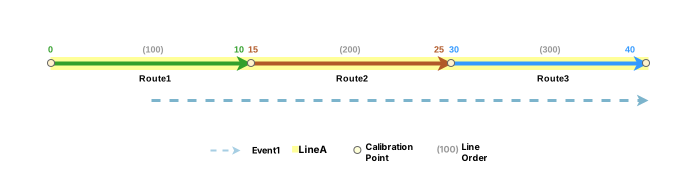
The following diagram shows the routes and their associated event before the edit:
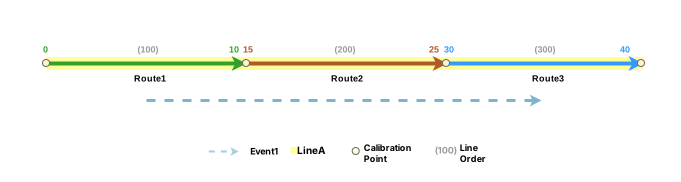
The following table details the route attributes. Valid measures for an event on Line A must fall between 0 on Route 1 and 40 on Route 3, and valid dates must fall on or after 1/1/2000.
| Route ID | From Date | To Date |
|---|---|---|
| Route1 | 1/1/2000 | <Null> |
| Route2 | 1/1/2000 | <Null> |
| Route3 | 1/1/2000 | <Null> |
The following table details the event before editing using the attribute table. Event 1 is a spanning event that has measures from 5 on Route 1 to 35 on Route 3.
| Event ID | From Route ID | To Route ID | From Date | To Date | From Measure | To Measure | Location Error | MAOP Design |
|---|---|---|---|---|---|---|---|---|
| Event1 | Route1 | Route3 | 1/1/2000 | <Null> | 5 | 35 | No Error | 800 |
| Event ID | From Route ID | To Route ID | From Date | To Date | From Measure | To Measure | Location Error | Speed Limit |
|---|---|---|---|---|---|---|---|---|
| Event1 | Route1 | Route3 | 1/1/2000 | <Null> | 5 | 35 | No Error | 55 |
The following diagram shows the routes after the line event (Event 1) is updated. The Event 1 starting measure changed from 5 to 0 on 1/1/2005.
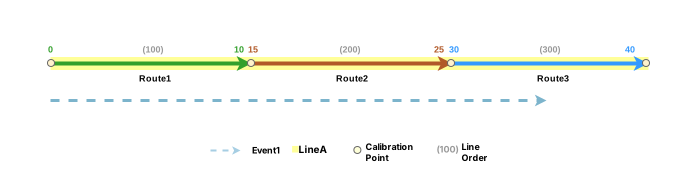
The following table details the event after the measure has changed from 5 to 0 for Route 1, which causes a change in its shape. Additionally, the MAOP Design value for the event record has been updated from 800 to 810.
| Event ID | From Route ID | To Route ID | From Date | To Date | From Measure | To Measure | Location Error | MAOP Design |
|---|---|---|---|---|---|---|---|---|
| Event1 | Route1 | Route3 | 1/1/2005 | <Null> | 0 | 35 | No Error | 810 |
The following table details the event after the measure has changed from 5 to 0 for Route 1, which causes a change in its shape. Additionally, the Speed Limit value for the event record has been updated from 55 to 65.
| Event ID | From Route ID | To Route ID | From Date | To Date | From Measure | To Measure | Location Error | Speed Limit |
|---|---|---|---|---|---|---|---|---|
| Event1 | Route1 | Route3 | 1/1/2000 | <Null> | 0 | 35 | No Error | 65 |
Spanning event measure editing resulting in a location error
The following diagram shows the routes and their associated event before the edit:
The following table details the route attributes. Valid measures for an event on Line A must fall between 0 on Route 1 and 40 on Route 3, and valid dates must fall on or after 1/1/2000.
| Route ID | From Date | To Date |
|---|---|---|
| Route1 | 1/1/2000 | <Null> |
| Route2 | 1/1/2000 | <Null> |
| Route3 | 1/1/2000 | <Null> |
The following table details the event before editing using the attribute table. Event 1 is a spanning event that has measures from 5 on Route 1 to 35 on Route 3.
| Event ID | From Route ID | To Route ID | From Date | To Date | From Measure | To Measure | Location Error | MAOP Design |
|---|---|---|---|---|---|---|---|---|
| Event1 | Route1 | Route3 | 1/1/2000 | <Null> | 5 | 35 | No Error | 800 |
| Event ID | From Route ID | To Route ID | From Date | To Date | From Measure | To Measure | Location Error | Speed Limit |
|---|---|---|---|---|---|---|---|---|
| Event1 | Route1 | Route3 | 1/1/2000 | <Null> | 5 | 35 | No Error | 55 |
During the edit, the Event 1 end measure is correctly edited from 35 to 40 on Route 3; however, the To Route ID value is inadvertently deleted, which results in an Invalid Location Route ID error for the system-provided Location Error field.
The following diagram shows the routes after the event shape is no longer generated due to the transcription error in the attribute table row:
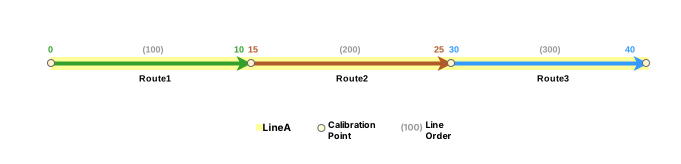
The following table shows the missing To Route ID value and the To Measure value, which is null:
| Event ID | From Route ID | To Route ID | From Date | To Date | From Measure | To Measure | Location Error | MAOP Design |
|---|---|---|---|---|---|---|---|---|
| Event1 | Route1 | None | 1/1/2000 | <Null> | 5 | <Null> | Invalid Location Route ID | 800 |
| Event ID | From Route ID | To Route ID | From Date | To Date | From Measure | To Measure | Location Error | Speed Limit |
|---|---|---|---|---|---|---|---|---|
| Event1 | Route1 | 1/1/2000 | <Null> | 5 | <Null> | Invalid Location Route ID | 55 |
In such cases, review the attribute table and restore any missing or incorrect values to generate the event shape. In this case, reinstate the To Route ID and re-enter the cleared end measure value of 40.
| Event ID | From Route ID | To Route ID | From Date | To Date | From Measure | To Measure | Location Error | MAOP Design |
|---|---|---|---|---|---|---|---|---|
| Event1 | Route1 | Route3 | 1/1/2000 | <Null> | 5 | 40 | No Error | 800 |
| Event ID | From Route ID | To Route ID | From Date | To Date | From Measure | To Measure | Location Error | Speed Limit |
|---|---|---|---|---|---|---|---|---|
| Event1 | Route1 | Route3 | 1/1/2000 | <Null> | 5 | 40 | No Error | 55 |
The following diagram shows the event measure edit after the To Route ID value and the To Measure (40) are restored:
Scenarios for time slicing an event using the attribute table
Depending on the type of edit you make to an event, you may need to change the event's start and end dates to reflect a real-world change that occurs on a specific date. You can update the start and end dates by either using an existing event record or adding an event record using the same event ID and route ID with different dates to represent a specific time range. Representing changes to an event in this manner is known as time slicing and ensures that event changes are accurately stored for each point in time.
The scenario below details a route that has two time slices and an associated line event whose dates only cover one of the route's time slices. The first route time slice has dates from 1/1/2000 to 12/31/2010, and the second route time slice has dates from 1/1/2012 to <Null>. The event record dates are from 1/1/2000 to 12/31/2010.
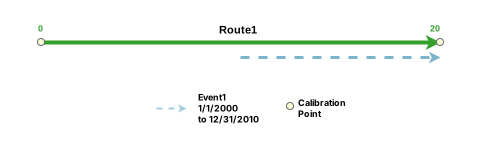
The following table details the route attributes, including time slices:
| Route ID | From Date | To Date |
|---|---|---|
| Route1 | 1/1/2000 | 12/31/2010 |
| Route1 | 1/1/2012 | <Null> |
The following table details the event before the edit:
| Event ID | Route ID | From Date | To Date | From Measure | To Measure | Location Error | MAOP Design |
|---|---|---|---|---|---|---|---|
| Event1 | Route1 | 1/1/2000 | 12/31/2010 | 10 | 20 | No Error | 800 |
| Event ID | Route ID | From Date | To Date | From Measure | To Measure | Location Error | Speed Limit |
|---|---|---|---|---|---|---|---|
| Event1 | Route1 | 1/1/2000 | 12/31/2010 | 10 | 20 | No Error | 55 |
In this case, the explicit to date of Event 1 is updated to match both route time slices by changing its To Date to <Null> to match the To Date of the latest time slice of the route.
The following diagram shows the route and the updated event record after the edit:
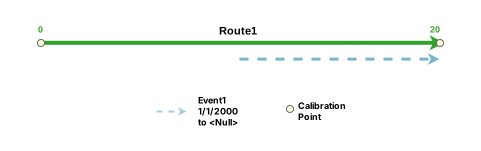
The following table details the event after the edit. Event 1 now has three time slices. The original time slice retains its date range from 1/1/2000 to 12/31/2010, which matches the first time slice of the route. The second time slice has dates from 12/31/2010 to 1/1/2012, but the route doesn't exist between those dates, which results in a Route Not Found error in that time slice. The third time slice has dates from 1/1/2012 to <Null> that match the latest route time slice.
| Event ID | Route ID | From Date | To Date | From Measure | To Measure | Location Error | MAOP Design |
|---|---|---|---|---|---|---|---|
| Event1 | Route1 | 1/1/2000 | 12/31/2010 | 10 | 20 | No Error | 800 |
| Event1 | Route1 | 12/31/2010 | 1/1/2012 | 10 | 20 | Route Not Found | 800 |
| Event1 | Route1 | 1/1/2012 | <Null> | 10 | 20 | No Error | 800 |
| Event ID | Route ID | From Date | To Date | From Measure | To Measure | Location Error | Speed Limit |
|---|---|---|---|---|---|---|---|
| Event1 | Route1 | 1/1/2000 | 12/31/2010 | 10 | 20 | No Error | 55 |
| Event1 | Route1 | 12/31/2010 | 1/1/2012 | 10 | 20 | Route Not Found | 55 |
| Event1 | Route1 | 1/1/2012 | <Null> | 10 | 20 | No Error | 55 |
Referent offset and event editing using the attribute table
The LRS events data model supports the configuration of event referent fields and their enablement using the Enable Referent Fields tool. Once referent fields are configured and enabled in a layer, referent locations are populated and persisted in that layer when events are added or edited.
When a line event is edited using the attribute table in a referent-enabled layer, the parent LRS Network is used as the FromRefMethod and ToRefMethod values by default, and the route is used as the FromRefLocation and ToRefLocation values. The start and end measures of the line event are used as the FromRefOffset and ToRefOffset values.
If either measure of a line event is updated, the corresponding offset value updates to reflect the new measure.
The example below demonstrates the impact of editing event records in the attribute table.
Before event editing with referents
In this example, Event 1 is a line event record in a referent-enabled layer. Point Event Layer 1 refers to a point event layer as its FromRefMethod and ToRefMethod values and uses a point event in that layer, Point1, as its FromRefLocation and ToRefLocation values.
The following diagram shows the route and its associated events:
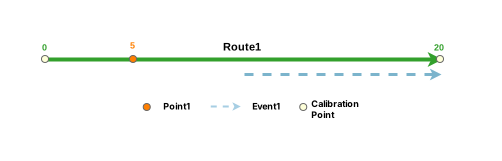
The following table provides details about the event referent fields before editing using the attribute table:
| FromRefMethod | FromRefLocation | FromRefOffset | ToRefMethod | ToRefLocation | ToRefOffset |
|---|---|---|---|---|---|
| PointEventLayer1 | Point1 | 5 | PointEventLayer1 | Point1 | 15 |
The following table provides details about the other event fields before the edit:
| Event ID | Route ID | From Date | To Date | From Measure | To Measure |
|---|---|---|---|---|---|
| Event1 | Route1 | 1/1/2000 | <Null> | 10 | 20 |
After event editing with referents
The following diagram shows the route and its associated events after the edit:
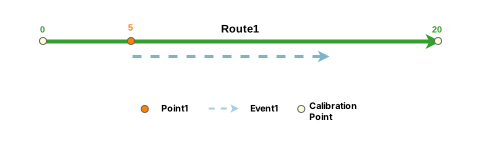
The following table provides details about the event referent fields after the edit:
| FromRefMethod | FromRefLocation | FromRefOffset | ToRefMethod | ToRefLocation | ToRefOffset |
|---|---|---|---|---|---|
| PipeSeriesNetwork | Route1 | 5 | PipeSeriesNetwork | Route1 | 15 |
| FromRefMethod | FromRefLocation | FromRefOffset | ToRefMethod | ToRefLocation | ToRefOffset |
|---|---|---|---|---|---|
| AllRoutes | Route1 | 5 | AllRoutes | Route1 | 15 |
The following table provides details about the other event fields after the edit:
| Event ID | Route ID | From Date | To Date | From Measure | To Measure |
|---|---|---|---|---|---|
| Event1 | Route1 | 1/1/2000 | <Null> | 5 | 15 |