Event behavior for cartographic realignment
 Available with the Linear Referencing license.
Cartographic realignment is the method of updating the route geometry based on aerial imagery, as-built drawings, or input from field data collectors. To do this, you can directly modify the centerline that is associated with the route.
Learn more about applying cartographic realignment
Note:
Events are not updated until you run the Apply Event Behaviors tool after route edits. If conflict prevention is enabled, you are prompted to run the Apply Event Behaviors tool before posting to the default version.
Cartographic realignment scenario
When cartographic realignment occurs, events are impacted depending on the configured event behavior for the event layer.
The following are the results of running the Apply Event Behaviors tool on event features:
| Behavior | Description |
|---|---|
| Honor Route Measure | Preserves the measure of the event and changes shape according to the route. |
| Honor Referent Location | Changes both measure and geographic location to maintain the referent location of the event using a persistent offset value. |
Note:
When the Update route measures in cartographic realignment property is enabled in a linear referencing system (LRS) Network in which cartographic realignment is performed, the route's measures can change after cartographic realignment. Subsequently, the configured cartographic realignment event behavior and calibrate event behavior are both applied to events in impacted sections on the route.
You can review the configured event behaviors per edit type by viewing the LRS event properties.
For all examples in this topic, the Update route measures in cartographic realignment property is disabled.
For all examples in this topic, the Update route measures in cartographic realignment property is enabled.
Route cartographic realignment results
In this example, Route 1 is active from 1/1/2000. The cartographic realignment is set to occur on 1/1/2005 where an incorrect curve is fixed. Route 1's measures do not change because the Update route measures in cartographic realignment property is disabled for the network. The graphics and tables in the following sections demonstrate the route information before and after the cartographic realignment.
In this example, Route 1 is active from 1/1/2000. The cartographic realignment is set to occur on 1/1/2005 where an incorrect curve is fixed. Route 1's measures adjust to its new geometry because the Update route measures in cartographic realignment property is enabled for the network. The graphics and tables in the following sections demonstrate the route information before and after the cartographic realignment.
Route before cartographic realignment
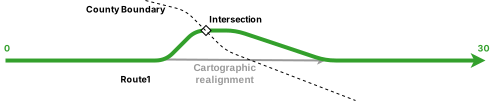
The following image shows the route before cartographic realignment. There is an intersection on Route 1 where it intersects the county boundary. The intersection is the referent location in the following Honor Referent Location event behavior scenario.
The following tables provide details about the route and intersection before cartographic realignment:
| Route Name | From Date | To Date | From Measure | To Measure |
|---|---|---|---|---|
| Route1 | 1/1/2000 | <Null> | 0 | 30 |
| Intersection ID | From Date | To Date | Route Name | Measure |
|---|---|---|---|---|
| Intersection | 1/1/2000 | <Null> | Route1 | 12 |
| Route ID | From Date | To Date | From Measure | To Measure |
|---|---|---|---|---|
| Route1 | 1/1/2000 | <Null> | 0 | 30 |
| Intersection ID | From Date | To Date | Route ID | Measure |
|---|---|---|---|---|
| Intersection | 1/1/2000 | <Null> | Route1 | 12 |
Route after cartographic realignment
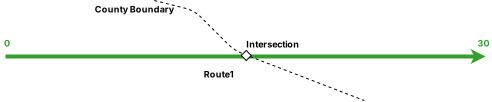
The following image shows the route and intersection after cartographic realignment:
The following tables provide details about the route and intersection after cartographic realignment:
| Route Name | From Date | To Date | From Measure | To Measure |
|---|---|---|---|---|
| Route1 | 1/1/2000 | <Null> | 0 | 30 |
| Intersection ID | From Date | To Date | Route Name | Measure |
|---|---|---|---|---|
| Intersection | 1/1/2000 | <Null> | Route1 | 15 |
Note:
When the centerlines are edited, all routes in all networks, across all times, are modified accordingly. Consequently, Route 1 does not get a new time slice, but its shape is changed in the existing time slice.
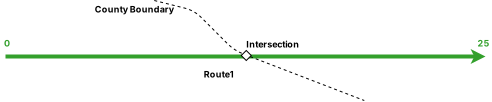
The following tables provide details about the route and intersection after cartographic realignment:
| Route ID | From Date | To Date | From Measure | To Measure |
|---|---|---|---|---|
| Route1 | 1/1/2000 | <Null> | 0 | 25 |
| Intersection ID | From Date | To Date | Route ID | Measure |
|---|---|---|---|---|
| Intersection | 1/1/2000 | <Null> | Route1 | 13 |
Note:
When the centerlines are edited, all routes in all networks, across all times, are modified accordingly. Consequently, Route 1 does not get a new time slice, but its shape is changed in the existing time slice.
The intersection's shape and measure are also updated after running Generate Intersections. The intersection does not get a new time slice because its associated route does not time slice.
Events before route cartographic realignment
There is a point event on Route 1 and it has a start date of 1/1/2000. The following image shows the route and event before cartographic realignment:

The following table provides details about the event before cartographic realignment:
| Event | Route Name | From Date | To Date | Measure |
|---|---|---|---|---|
| Event1 | Route1 | 1/1/2000 | <Null> | 17 |
| Event | Route ID | From Date | To Date | Measure |
|---|---|---|---|---|
| Event1 | Route1 | 1/1/2000 | <Null> | 17 |
The following sections describe how event behavior rules are enforced after running the Apply Event Behaviors tool with this route cartographic realignment scenario.
Note:
For a line event, its start and end points follow the same cartographic realignment event behavior as a point event.
Honor Route Measure behavior
The Honor Route Measure event behavior preserves the measures of the event and updates the event's location if the route's measures have not changed because the Update route measures in cartographic realignment parameter is disabled for the network.
Note:
If the Update route measures in cartographic realignment property is enabled for the network and the route's measures are updated due to cartographic realignment, the resulting event behavior will be a combination of cartographic realignment behavior and calibrate behavior. Events in the cartographic realignment area will move proportionally.
The route cartographic realignment edit activity with the Honor Route Measure event behavior has the following effect:
Event 1 is within cartographic realignment. Because the route's measures have not changed, the cartographic realignment Honor Route Measure event behavior is the only effective event behavior. Event 1's geographic location is updated, but its measure value remains the same, which is measure 17 on Route 1.
The following image shows the route and event after cartographic realignment:

Note:
Because cartographic realignment does not change a route's time slice, the time slice of the event on the route doesn't change either.
The following table provides details about the event after cartographic realignment:
| Event | Route Name | From Date | To Date | Measure |
|---|---|---|---|---|
| Event1 | Route1 | 1/1/2000 | <Null> | 17 |
If the Update route measures in cartographic realignment property is enabled for the network and the route's measures are updated due to cartographic realignment, the resulting event behavior will be a combination of the cartographic realignment behavior and the calibrate behavior. Events in the cartographic realignment area will move proportionally.
Note:
If the route measures have not changed because the Update route measures in cartographic realignment property is disabled for the network, the Honor Route Measure event behavior preserves the measures of the event and updates the event's location.
The following table shows the edit activities involved in the route edit and their corresponding event behaviors:
| Edit activity | Event behavior |
|---|---|
| Cartographic realignment | Honor Route Measure |
| Calibrate | Stay Put |
The route cartographic realignment described above has the following effect:
Event 1 was located on Route 1 at measure 17. Because it is within cartographic realignment and the route's measures have changed, both the cartographic realignment Honor Route Measure and the calibrate Stay Put behaviors are applied. Event 1's measure is updated proportionally to measure 14.2 on Route 1, and its location is also updated to stay on Route 1.
The following image shows the route and event after cartographic realignment:

Note:
Because cartographic realignment does not change a route's time slice, the time slice of the event on the route doesn't change either.
The following table provides details about the event after cartographic realignment:
| Event | Route ID | From Date | To Date | Measure |
|---|---|---|---|---|
| Event1 | Route1 | 1/1/2000 | <Null> | 14.2 |
Honor Referent Location behavior
The Honor Referent Location event behavior preserves the referent offset of the event and updates the event's geographic location and measures.
Events can have event referent fields to derive its location using referent location information. The following referent locations can be stored:
Offset distance from any point feature in the geodatabase
Offset distance from an intersection point feature
Offset distance from a point event feature
Offset distance from an x,y coordinate
Offset distance from a station
The following table shows referent fields in Event 1:
| Event | Route Name | Referent Location | Referent Offset |
|---|---|---|---|
| Event1 | Route1 | Intersection | 5 |
The route cartographic realignment edit activity with the Honor Referent Location event behavior has the following effect:
Event 1 was located 5 miles downstream of the intersection on Route 1, resulting in a measure of 17. After the cartographic realignment is applied, the intersection's measure is updated to 15 on Route 1. When the cartographic realignment Honor Referent Location behavior is applied to Event 1, it is still located 5 miles downstream of the intersection. The measure of Event 1 is updated to 20 on Route 1.
The following image shows the route and event after cartographic realignment:

Note:
Because cartographic realignment does not change a route's time slice, the time slice of the event on the route doesn't change either.
The following table provides details about the event after cartographic realignment:
| Event | Route Name | From Date | To Date | Measure |
|---|---|---|---|---|
| Event1 | Route1 | 1/1/2000 | <Null> | 20 |
The following table shows the edit activities involved in the route edit and their corresponding event behaviors:
| Edit activity | Event behavior |
|---|---|
| Cartographic realignment | Honor Referent Location |
| Calibrate | Stay Put |
The following table shows referent fields in Event 1:
| Event | Route ID | Referent Location | Referent Offset |
|---|---|---|---|
| Event1 | Route1 | Intersection | 5 |
The route cartographic realignment described above has the following effect:
Event 1 was located 5 miles downstream of the intersection on Route 1, resulting in a measure of 17. After the cartographic realignment is applied, the intersection's measure is updated to 13 on Route 1. When the cartographic realignment Honor Referent Location behavior is applied to Event 1, it is still located 5 miles downstream of the intersection. The measure of Event 1 is updated to 18 on Route 1.
The following image shows the route and event after cartographic realignment:

Note:
Because cartographic realignment does not change a route's time slice, the time slice of the event on the route doesn't change either.
The following table provides details about the event after cartographic realignment:
| Event | Route ID | From Date | To Date | Measure |
|---|---|---|---|---|
| Event1 | Route1 | 1/1/2000 | <Null> | 18 |
Cartographic realignment on routes in a line network with events that span routes
Routes in a line network can also be cartographically realigned by modifying the associated centerline.
In the following example, there are two routes on Line A and the routes are active from 1/1/2000. The cartographic realignment is set to occur on 1/1/2005 from the middle to the end of Route 2. Route 2's measures remain unchanged because the Update route measures in cartographic realignment property is disabled for the network. The images and tables in the following sections demonstrate the route information before and after the cartographic realignment.
In the following example, there are two routes on Line A and the routes are active from 1/1/2000. The cartographic realignment is set to occur on 1/1/2005 from the middle to the end of Route 2. Route 2's measures adjust to its new geometry because the Update route measures in cartographic realignment property is enabled for the network. The images and tables in the following sections demonstrate the route information before and after the cartographic realignment.
Routes before cartographic realignment
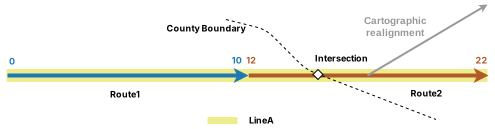
The following image shows the routes before cartographic realignment. There is an intersection on Route 2 where Route 2 intersects the county boundary. The intersection is the referent location in the following Honor Referent Location event behavior scenario.
Note:
The length of cartographic realignment is 1.3 times longer than the part of the route being cartographically realigned.
The following tables provide details about the routes and intersection before cartographic realignment:
| Route Name | Line Name | Line Order | From Date | To Date | From Measure | To Measure |
|---|---|---|---|---|---|---|
| Route1 | LineA | 100 | 1/1/2000 | <Null> | 0 | 10 |
| Route2 | LineA | 200 | 1/1/2000 | <Null> | 12 | 22 |
| Intersection ID | From Date | To Date | Route Name | Measure |
|---|---|---|---|---|
| Intersection | 1/1/2000 | <Null> | Route2 | 15 |
Routes after cartographic realignment
The following image shows the route and intersection after cartographic realignment:
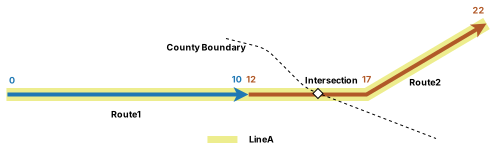
The following tables provide details about the routes and intersection after cartographic realignment:
| Route Name | Line Name | Line Order | From Date | To Date | From Measure | To Measure |
|---|---|---|---|---|---|---|
| Route1 | LineA | 100 | 1/1/2000 | <Null> | 0 | 10 |
| Route2 | LineA | 200 | 1/1/2000 | <Null> | 12 | 22 |
| Intersection ID | From Date | To Date | Route Name | Measure |
|---|---|---|---|---|
| Intersection | 1/1/2000 | <Null> | Route2 | 15 |
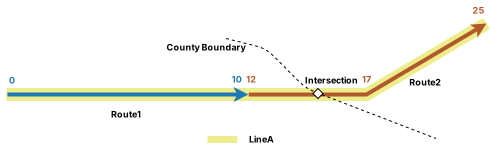
The following tables provide details about the routes and intersection after cartographic realignment:
| Route Name | Line Name | Line Order | From Date | To Date | From Measure | To Measure |
|---|---|---|---|---|---|---|
| Route1 | LineA | 100 | 1/1/2000 | <Null> | 0 | 10 |
| Route2 | LineA | 200 | 1/1/2000 | <Null> | 12 | 25 |
| Intersection ID | From Date | To Date | Route Name | Measure |
|---|---|---|---|---|
| Intersection | 1/1/2000 | <Null> | Route2 | 15 |
Note:
When the centerlines are edited, all routes in all networks, across all times, are modified accordingly. Consequently, Route 2 does not get a new time slice, but its shape is changed in the existing time slice.
Events before route cartographic realignment
There is a point event on Route 2 and it has a start date of 1/1/2000. The following image shows the routes and event before cartographic realignment:
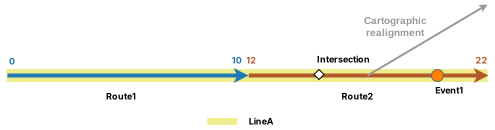
The following table provides details about the event before cartographic realignment:
| Event | Route Name | From Date | To Date | Measure |
|---|---|---|---|---|
| Event1 | Route2 | 1/1/2000 | <Null> | 20 |
The following sections describe how event behavior rules are enforced after running the Apply Event Behaviors tool under this route cartographic realignment scenario.
Note:
For a line event, its start and end points follow the same cartographic realignment event behavior as a point event.
Honor Route Measure behavior
The Honor Route Measure event behavior preserves the measures of the event and updates the event's location if the route's measures have not changed because the Update route measures in cartographic realignment parameter is disabled for the network.
Note:
If the Update route measures in cartographic realignment property is enabled for the network and the route measures are updated due to cartographic realignment, the resulting event behavior will be a combination of the cartographic realignment behavior and the calibrate behavior. Events in the cartographic realignment area will move proportionally.
The route cartographic realignment edit activity with the Honor Route Measure event behavior has the following effect:
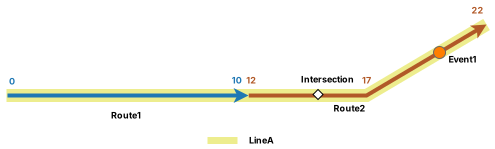
Event 1 is within cartographic realignment. Because the route's measures have not changed, the cartographic realignment Honor Route Measure event behavior is the only effective event behavior. Event 1's geographic location is updated, but its measure value remains the same, which is measure 20 on Route 2.
The following image shows the routes and event after cartographic realignment:
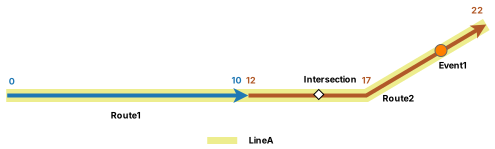
Note:
Because cartographic realignment does not change a route's time slice, the time slice of the event on the route doesn't change either.
The following table provides details about the event after cartographic realignment:
| Event | Route Name | From Date | To Date | Measure |
|---|---|---|---|---|
| Event1 | Route2 | 1/1/2000 | <Null> | 20 |
If the Update route measures in cartographic realignment property is enabled for the network and the route measures are updated due to cartographic realignment, the resulting event behavior will be a combination of the cartographic realignment behavior and the calibrate behavior. Events in the cartographic realignment area will move proportionally.
Note:
If the route measures have not changed because the Update route measures in cartographic realignment property is disabled for the network, the Honor Route Measure event behavior preserves the measures of the event and updates the event's location.
The following table shows the edit activities involved in the route edit and their corresponding event behaviors:
| Edit activity | Event behavior |
|---|---|
| Cartographic realignment | Honor Route Measure |
| Calibrate | Stay Put |
The route cartographic realignment described above has the following effect:
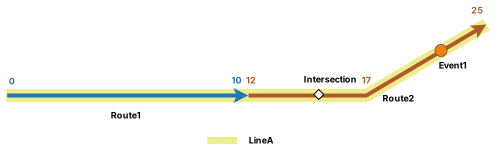
Event 1 was located on Route 2 at measure 20. Because it is within cartographic realignment and the route measures have changed, both the cartographic realignment Honor Route Measure and the calibrate Stay Put behaviors are applied. Event 1's measure is updated proportionally to measure 22.4 on Route 2, and its location is also updated to stay on Route 2.
The following image shows the routes and event after cartographic realignment:
Note:
Because cartographic realignment does not change a route's time slice, the time slice of the events on the route doesn't change either.
The following table provides details about the event after cartographic realignment:
| Event | Route Name | From Date | To Date | Measure |
|---|---|---|---|---|
| Event1 | Route2 | 1/1/2000 | <Null> | 22.4 |
Honor Referent Location behavior
The Honor Referent Location event behavior preserves the referent offset of the event and updates the event's geographic location and measures.
Events can have event referent fields to derive its location using referent location information. The following referent locations can be stored:
Offset distance from any point feature in the geodatabase
Offset distance from an intersection point feature
Offset distance from a point event feature
Offset distance from an x,y coordinate
Offset distance from a station
The following table shows the edit activities involved in the route edit and their corresponding event behaviors:
| Edit activity | Event behavior |
|---|---|
| Cartographic realignment | Honor Referent Location |
| Calibrate | Stay Put |
The following table shows referent fields in Event 1:
| Event | Route Name | Referent Location | Referent Offset |
|---|---|---|---|
| Event1 | Route2 | Intersection | 5 |
The route cartographic realignment edit activity with the Honor Referent Location event behavior has the following effect:
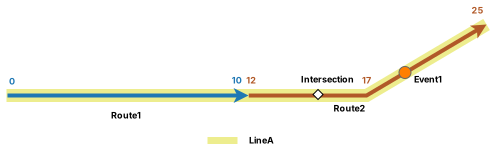
Event 1 was located 5 miles downstream of the intersection on Route 2, resulting in a measure of 20. After the cartographic realignment is applied, it is still located 5 miles downstream of the intersection, which is measure 20 on Route 2. The location of Event 1 is updated to stay on Route 2.
The following image shows the routes and event after cartographic realignment:
The following table provides details about the event after cartographic realignment:
| Event | Route Name | From Date | To Date | Measure |
|---|---|---|---|---|
| Event1 | Route2 | 1/1/2000 | <Null> | 20 |