LRS Network
 Available with the Linear Referencing license.
ArcGIS Linear Referencing supports three types of networks: nonline network, line network, and derived network.
Nonline network
A nonline network is a collection of routes measured to a specific linear referencing method (LRM).
Nonline network example
Some examples of nonline networks include odometer networks and county networks.
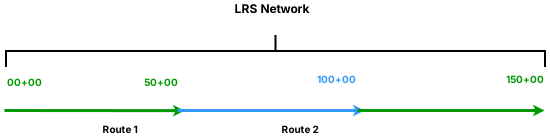
The following diagram shows an example of a nonline network:
Line network
A line network is a logical grouping of routes to a line where the measure can increase or decrease monotonically. This type of network supports events that span routes and also supports equations.
Line network example
A line network feature class includes the required fields to be modeled as a line network.
The following diagram and table show an example of a line network:

| Route ID | Route Name | Line Order | Line ID | Line Name |
|---|---|---|---|---|
| {1838BE01-0BC9-4C58-9829-0F1D77717DCB} | Route 1 | 100 | {C043CAF0-2BF7-4598-8AC8-B382647AD490} | Line A |
| {26710A05-C499-42C1-BB73-D3A8D402B109} | Route 2 | 200 | {C043CAF0-2BF7-4598-8AC8-B382647AD490} | Line A |
| {5582FB08-84E3-49D4-8781-1D3EF7B4F2E2} | Route 3 | 300 | {C043CAF0-2BF7-4598-8AC8-B382647AD490} | Line A |
Derived network
A derived network is a network generated from a line network. In a derived network, routes that belong to the same line are merged to create one route with a start measure of zero.
Derived network example
Using a line network as the parent network, the continuous network's routes can be derived. A derived network is a collection of routes where the measures are continuous, such as a nonbranching run of a physical pipe. These measures can then be used for length reporting and dynamic segmentation analysis.
Using a line network as the parent network, the continuous network's routes can be derived. A derived network is a collection of routes where the measures are continuous. These measures can then be used for length reporting and dynamic segmentation analysis.
The following diagram shows an example of a derived network:

Why different types of LRS Networks are needed
ArcGIS Linear Referencing supports multiple linear referencing methods in a single geodatabase. Business units in an organization may need to report measures in many different LRMs. For example, engineering and construction may need to collect, maintain, and report events in engineering measures (also known as engineering stations), whereas other business entities need to report measures based on continuous length.
There is no limit on the number of networks that you can create in an LRS. However, the type of LRS Networks you need depends on your organization’s business process.
Consider the following example use cases:
In a pipeline organization, there are three business units that collect, manage, and maintain pipeline assets. These three business units are surveying, engineering and construction, and regulatory and compliance.
The surveying group is in charge of collecting inline inspection (ILI) data, whereas the engineering and construction group is responsible for new construction, realignments, and work order management. The regulatory and compliance group is tasked with submitting and generating reports for the Pipeline and Hazardous Materials Safety Administration (PHMSA) and other government entities.
In this case, the three business units need three network types:
Nonline network—ILI runs can be loaded in this type of network using the Append Events tool. A nonline network maintains continuous and uninterrupted measures for ILI data based on odometer readings.
Line network—Data such as anomalies can be extracted from ILI data using the Translate Event Measures tool and transformed into a line network. Anomaly events can be used to report measures based on engineering measures for the engineering and construction group.
Derived network—This type of network can be used for mileage or PHMSA reporting. Events can't be registered to this type of network.
Learn more about configuring events to store derived measures
When different types of LRS Networks are required
Every organization's business processes are different. If your business process only requires one type of network, you do not have to configure multiple networks. For example, if your business process requires continuous measures to be maintained and reported, then you can configure your LRS to only support a nonline network. Similarly, if your business process collects and maintains data with equation points or other engineering stationing, you can configure a line network to maintain the data as it is collected and a derived network for continuous measure reporting. In this scenario, you can also configure events to store derived measures.
Note:
The derived network is generated from the line network. If you don't configure a line network, you can't configure a derived network.