Event behavior for route retirement
 Available with the Linear Referencing license.
When you retire a route, events are impacted depending on the configured event behavior for the event layer.
Note:
Events are not updated until you run the Apply Event Behaviors tool after route edits. If conflict prevention is enabled, you are prompted to run the Apply Event Behaviors tool before posting to the default version.
When you check the Recalibrate route downstream option during route editing, the tool applies the event behavior for route calibration to downstream sections. You can review configured event behaviors by viewing the LRS event properties.
The following sections describe route retirement and the corresponding event behaviors.
Route retirement scenario
A route can be retired at the beginning, in the middle, or at the end of the route. If the retirement takes place in the middle of the route, the resulting route is a gapped route. For line network, you can fully or partially retire multiple adjoining routes that belong to the same line.
Upstream and downstream sections
Route editing impacts upstream and downstream sections differently.
The following diagram shows the upstream and downstream sections for the route retirement scenario:

The following table details how the retirement editing activity impacts upstream and downstream events according to the configured event behavior:
| Behavior | Events upstream | Events intersecting | Events downstream |
|---|---|---|---|
| Stay Put | No action. | Retire event; line events crossing the edit region are split and the original event is retired. | If route calibration is changed, the Calibrate event behavior is applied; otherwise, no action is taken. |
| Move | Shape regenerated, if needed, to new location of route measures. | Shape regenerated to new location of route measures. | If route calibration is changed, the Calibrate event behavior is applied; otherwise, no action is taken. |
| Retire | No action. | Retire event; line events crossing the edit region are not split. | If route calibration is changed, the Calibrate event behavior is applied; otherwise, no action is taken. |
| Snap | No action | Retire event; line events crossing the edit section are split. The new event is snapped to a concurrent route, if one exists. | If route calibration is changed, the Calibrate event behavior is applied; otherwise, no action is taken. |
Note:
The network can contain events that span routes in a line network. The behaviors are still applied in the same manner.
Because the linear referencing system (LRS) is time aware, edit activities such as retiring a route time slice routes and events.
Route retirement results
In this example, Route 1 is active from 1/1/2000. The retirement is set to occur at the beginning of the route on 1/1/2005. The Recalibrate route downstream option is not checked. The following diagrams and tables demonstrate the route information before and after the retirement.
In this example, Route 1 is active from 1/1/2000. The retirement is set to occur at the beginning of the route on 1/1/2005. The Recalibrate route downstream option is checked and the route is recalibrated after retirement. The following diagrams and tables demonstrate the route information before and after the retirement.
Note:
- In the following examples, the Calibrate event behavior for the events is set to Stay Put. The Calibrate event behavior is applied before the Retire event behavior, so it is important to verify the event feature layer's Calibrate event behavior configuration before checking the Recalibrate route downstream check box.
For other event behaviors for calibration, refer to the Calibrate event behavior topic.
Route before retirement
The following diagram shows the route before the retirement:

The following table provides details about the route before the retirement:
| Route Name | From Date | To Date | From Measure | To Measure |
|---|---|---|---|---|
| Route1 | 1/1/2000 | <Null> | 0 | 55 |
| Route ID | From Date | To Date | From Measure | To Measure |
|---|---|---|---|---|
| Route1 | 1/1/2000 | <Null> | 0 | 55 |
Route after retirement
The following diagram shows the route after the retirement:

The following table provides details about the route after the retirement:
| Route Name | From Date | To Date | From Measure | To Measure |
|---|---|---|---|---|
| Route1 | 1/1/2000 | 1/1/2005 | 0 | 55 |
| Route1 | 1/1/2005 | <Null> | 25 | 55 |

The following table provides details about the route after the retirement:
| Route ID | From Date | To Date | From Measure | To Measure |
|---|---|---|---|---|
| Route1 | 1/1/2000 | 1/1/2005 | 0 | 55 |
| Route1 | 1/1/2005 | <Null> | 0 | 30 |
Events before route retirement
There are three events on Route 1 and all of them have a start date of 1/1/2000. The following diagram shows the route and events before the retirement:
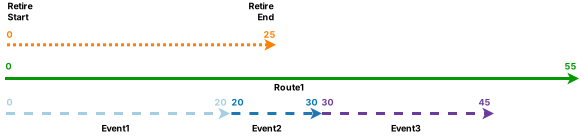
The following table provides details about the events before the retirement:
| Event | Route Name | From Date | To Date | From Measure | To Measure |
|---|---|---|---|---|---|
| Event1 | Route1 | 1/1/2000 | <Null> | 0 | 20 |
| Event2 | Route1 | 1/1/2000 | <Null> | 20 | 30 |
| Event3 | Route1 | 1/1/2000 | <Null> | 30 | 45 |
| Event | Route ID | From Date | To Date | From Measure | To Measure |
|---|---|---|---|---|---|
| Event1 | Route1 | 1/1/2000 | <Null> | 0 | 20 |
| Event2 | Route1 | 1/1/2000 | <Null> | 20 | 30 |
| Event3 | Route1 | 1/1/2000 | <Null> | 30 | 45 |
The following sections detail how event behavior rules are enforced after running the Apply Event Behaviors tool under this route retirement scenario.
Stay Put event behavior
Although the geographic location of the event is maintained, the measures can change. The event can also split if it crosses the retire region and portions within the retirement region are retired.
The Retire route edit activity with the Stay Put event behavior has the following effects:
Event 1 is retired on the date of the retirement because it is completely in the edit section.
Event 2 is retired on the date of the retirement because part of it is in the edit section. A new event is created on the post-retirement route with the retirement date as the start date. The length of the new Event 2 is shorter and its start measure changes to 25 and end measure changes to 30 to accommodate the new measures of Route 1.
Event 3 is not affected because it is not in the retirement region.
The following diagram shows the route and events after the retirement:

Note:
The retired event is not drawn in the previous diagram.
The following table provides details about the events after the retirement:
| Event | Route Name | From Date | To Date | From Measure | To Measure | Location Error |
|---|---|---|---|---|---|---|
| Event1 | Route1 | 1/1/2000 | 1/1/2005 | 0 | 20 | No Error |
| Event2 | Route1 | 1/1/2000 | 1/1/2005 | 20 | 30 | No Error |
| Event2 | Route1 | 1/1/2005 | <Null> | 25 | 30 | No Error |
| Event3 | Route1 | 1/1/2000 | <Null> | 30 | 45 | No Error |
The following table shows the edit activities involved in the route edit and their corresponding event behaviors:
| Edit activity | Event behavior |
|---|---|
| Retire | Stay Put |
| Calibrate | Stay Put |
The route retirement described above has the following effects:
Event 1 is retired on the date of the retirement because it is completely in the edit section.
Event 2 is retired on the date of the retirement because part of it is in the edit section. A new event is created on the post-retirement route with the retirement date as the start date. The length of the new Event 2 is shorter and its start measure changes to 0 and end measure changes to 5 to accommodate the new measures of Route 1.
Event 3 is not in the retirement region, so the Retire event behavior does not apply to it. As Route 1 is recalibrated, the calibration Stay Put behavior is applied to maintain Event 3's geographic location. Event 3's start measure value changes to 5 and end measure value changes to 20 to accommodate the new measures of Route 1.
The following diagram shows the route and events after the retirement:

Note:
The retired event is not drawn in the previous diagram.
The following table provides details about the events after the retirement:
| Event | Route ID | From Date | To Date | From Measure | To Measure | Location Error |
|---|---|---|---|---|---|---|
| Event1 | Route1 | 1/1/2000 | 1/1/2005 | 0 | 20 | No Error |
| Event2 | Route1 | 1/1/2000 | 1/1/2005 | 20 | 30 | No Error |
| Event2 | Route1 | 1/1/2005 | <Null> | 0 | 5 | No Error |
| Event3 | Route1 | 1/1/2000 | 1/1/2005 | 30 | 45 | No Error |
| Event3 | Route1 | 1/1/2005 | <Null> | 5 | 20 | No Error |
Move event behavior
Although the measures of the event are maintained, the geographic location can change.
The Retire route edit activity with the Move event behavior has the following effects:
Event 1 is retired on the date of the retirement because part of it is in the edit section. A new event is created on the post-retirement route with the retirement date as the starting date. Because the measures do not change for the Move behavior, the new Event 1 gets a location error while trying to locate Route 1, but Route 1 no longer exists. There is a record for the new Event 1 in the event table, but it is not drawn because it does not have a length due to the location error.
Event 2 is retired on the date of the retirement because it is completely in the edit section. A new event is created on the post-retirement route with the retirement date as the starting date. Because the measures do not change for the Move behavior, there is a location error for the start measure because that measure (20) no longer exists on Route 1. The shape of the new Event 2 can still be drawn because part of it can still be located on the new Route 1.
Event 3 is not affected as it is not in the retirement region.
The following diagram shows the route and events after the retirement:

The following table provides details about the events after the retirement:
| Event | Route Name | From Date | To Date | From Measure | To Measure | Location Error |
|---|---|---|---|---|---|---|
| Event1 | Route1 | 1/1/2000 | 1/1/2005 | 0 | 20 | No Error |
| Event1 | Route1 | 1/1/2005 | <Null> | 0 | 20 | Route Not Found |
| Event2 | Route1 | 1/1/2000 | 1/1/2005 | 20 | 30 | No Error |
| Event2 | Route1 | 1/1/2005 | <Null> | 20 | 30 | Partial match for From Measure |
| Event3 | Route1 | 1/1/2000 | <Null> | 30 | 45 | No Error |
The following table shows the edit activities involved in the route edit and their corresponding event behaviors:
| Edit activity | Event behavior |
|---|---|
| Retire | Move |
| Calibrate | Stay Put |
The route retirement described above has the following effects:
Event 1 is retired on the date of the retirement because part of it is in the edit section. A new event is created on the post-retirement route with the retirement date as the starting date. Because the measures do not change for the Move behavior, the event moves to the new location of Route 1 to maintain its original start measure value of 0 and end measure value of 20.
Event 2 is retired on the date of the retirement because it is completely in the edit section. A new event is created on the post-retirement route with the retirement date as the starting date. Because the measures do not change for the Move behavior, the event moves to the new location of Route 1 to maintain its original start measure value of 20 and end measure value of 30.
Event 3 is not in the retirement region, so the Retire event behavior does not apply to it. As Route 1 is recalibrated, the calibration Stay Put behavior is applied to maintain Event 3's geographic location. Event 3's start measure value changes to 5 and end measure value changes to 20 to accommodate the new measures of Route 1.
The following diagram shows the route and events after the retirement:

The following table provides details about the events after the retirement:
| Event | Route ID | From Date | To Date | From Measure | To Measure | Location Error |
|---|---|---|---|---|---|---|
| Event1 | Route1 | 1/1/2000 | 1/1/2005 | 0 | 20 | No Error |
| Event1 | Route1 | 1/1/2005 | <Null> | 0 | 20 | No Error |
| Event2 | Route1 | 1/1/2000 | 1/1/2005 | 20 | 30 | No Error |
| Event2 | Route1 | 1/1/2005 | <Null> | 20 | 30 | No Error |
| Event3 | Route1 | 1/1/2000 | 1/1/2005 | 30 | 45 | No Error |
| Event3 | Route1 | 1/1/2005 | <Null> | 5 | 20 | No Error |
Retire event behavior
Events intersecting the retire region are retired.
The Retire route edit activity with the Retire event behavior has the following effects:
Event 1 retires on the date of the retirement because it is completely inside the retired region.
Event 2 retires on the date of the retirement because it intersects the retired region.
Event 3 is not affected because it is not in the retirement region.
The following diagram shows the route and events after the retirement:

The following table provides details about the events after the retirement:
| Event | Route Name | From Date | To Date | From Measure | To Measure | Location Error |
|---|---|---|---|---|---|---|
| Event1 | Route1 | 1/1/2000 | 1/1/2005 | 0 | 20 | No Error |
| Event2 | Route1 | 1/1/2000 | 1/1/2005 | 20 | 30 | No Error |
| Event3 | Route1 | 1/1/2000 | <Null> | 30 | 45 | No Error |
The following table shows the edit activities involved in the route edit and their corresponding event behaviors:
| Edit activity | Event behavior |
|---|---|
| Retire | Retire |
| Calibrate | Stay Put |
The route retirement described above has the following effects:
Event 1 retires on the date of the retirement because it is completely inside the retired region.
Event 2 retires on the date of the retirement because it intersects the retired region.
Event 3 is not in the retirement region, so the Retire event behavior does not apply to it. As Route 1 is recalibrated, the calibration Stay Put behavior is applied to maintain Event 3's geographic location. Event 3's start measure value changes to 5 and end measure value changes to 20 to accommodate the new measures of Route 1.
The following diagram shows the route and events after the retirement:

The following table provides details about the events after the retirement:
| Event | Route ID | From Date | To Date | From Measure | To Measure | Location Error |
|---|---|---|---|---|---|---|
| Event1 | Route1 | 1/1/2000 | 1/1/2005 | 0 | 20 | No Error |
| Event2 | Route1 | 1/1/2000 | 1/1/2005 | 20 | 30 | No Error |
| Event3 | Route1 | 1/1/2000 | 1/1/2005 | 30 | 45 | No Error |
| Event3 | Route1 | 1/1/2005 | <Null> | 5 | 20 | No Error |
Snap event behavior
Although the geographic location of the event is maintained by snapping to the new route location of retirement, the measures can change. The event can also split if it crosses the retirement where concurrent routes exist.
In this example, there is a Route 2 that is concurrent with Route 1. Route 2 is in reversed direction and has the start measure value of 0 and end measure value of 55.
The route retirement edit activity with the Snap event behavior has the following effects:
Event 1 is retired on the date of the retirement because it is completely in the edit section. As a concurrent route exists in the retirement section, Event 1 snaps to Route 2, the concurrent route, after retirement. It is also reversed to accommodate the direction of Route 2. The new event record has the retirement date as the starting date. The new start measure value of Event 1 became 35 and the end measure value remained 55 on Route 2 to maintain Event 1's geographic location.
Event 2 is retired on the date of retirement since part of it is in the edit section. It then splits into two event records on the post-retirement routes with the retirement date as the starting date. This is because a concurrent route exists in the retirement section, and the portion of Event 2 in the retirement section snaps to Route 2, the concurrent route, after retirement. This portion of Event 2 is also reversed to accommodate the direction of Route 2. As a result, Event 2 splits into two pieces to maintain its geographic location. The first event record has the start measure value of 25 and end measure value of 30 on Route 1. The second event record snaps to Route 2 and has the start measure value of 30 and end measure value of 35 on Route 2.
Event 3 is not affected as it is not in the retirement region.
The following diagram shows the route and events after the retirement:

The following table provides details about the events after retirement:
| Event | Route Name | From Date | To Date | From Measure | To Measure | Location Error |
|---|---|---|---|---|---|---|
| Event1 | Route1 | 1/1/2000 | 1/1/2005 | 0 | 20 | No Error |
| Event1 | Route2 | 1/1/2005 | <Null> | 35 | 55 | No Error |
| Event2 | Route1 | 1/1/2000 | 1/1/2005 | 20 | 30 | No Error |
| Event2 | Route1 | 1/1/2005 | <Null> | 25 | 30 | No Error |
| Event2 | Route2 | 1/1/2005 | <Null> | 30 | 35 | No Error |
| Event3 | Route1 | 1/1/2005 | <Null> | 30 | 45 | No Error |
The following table shows the edit activities involved in the route edit and their corresponding event behaviors:
| Edit activity | Event behavior |
|---|---|
| Retire | Snap |
| Calibrate | Stay Put |
The route retirement described above has the following effects:
Event 1 is retired on the date of the retirement because it is completely in the edit section. As a concurrent route exists in the retirement section, Event 1 snaps to Route 2, the concurrent route, after retirement. It is also reversed to accommodate the direction of Route 2. The new event record has the retirement date as the starting date. The new start measure value of Event 1 became 35 and the end measure value remained 55 on Route 2 to maintain Event 1's geographic location.
Event 2 is retired on the date of retirement since part of it is in the edit section. It then splits into two event records on the post-retirement routes with the retirement date as the starting date. This is because a concurrent route exists in the retirement section, and the portion of Event 2 in the retirement section snaps to Route 2, the concurrent route, after retirement. This portion of Event 2 is also reversed to accommodate the direction of Route 2. As a result, Event 2 splits into two pieces to maintain its geographic location. The first event record has the start measure value of 0 and end measure value of 5 on Route 1 when the calibrate Stay Put behavior is applied. The second event record snaps to Route 2 and has the start measure value of 30 and end measure value of 35 on Route 2.
Event 3 is not in the retirement region, so the Retire event behavior does not apply to it. As Route 1 is recalibrated, the calibrate Stay Put behavior is applied to maintain Event 3's geographic location. Event 3's start measure value changes to 5 and end measure value changes to 20 to accommodate the new measures of Route 1.
The following diagram shows the route and events after the retirement:

The following table provides details about the events after retirement:
| Event | Route ID | From Date | To Date | From Measure | To Measure | Location Error |
|---|---|---|---|---|---|---|
| Event1 | Route1 | 1/1/2000 | 1/1/2005 | 0 | 20 | No Error |
| Event1 | Route2 | 1/1/2005 | <Null> | 35 | 55 | No Error |
| Event2 | Route1 | 1/1/2000 | 1/1/2005 | 20 | 30 | No Error |
| Event2 | Route1 | 1/1/2005 | <Null> | 0 | 5 | No Error |
| Event2 | Route2 | 1/1/2005 | <Null> | 30 | 35 | No Error |
| Event3 | Route1 | 1/1/2000 | 1/1/2005 | 30 | 45 | No Error |
| Event3 | Route1 | 1/1/2005 | <Null> | 5 | 20 | No Error |
Detailed behavior on routes in a line network with events that span routes
In this example, there are four routes on the same line and the routes are active from 1/1/2000. The retirement is set to occur on 1/1/2005 where the entire Route 1 and half of Route 2 are retired. The Recalibrate route downstream option is not checked. The following diagrams and tables demonstrate the route information before and after the retirement.
In this example, there are four routes on the same line and the routes are active from 1/1/2000. The retirement is set to occur on 1/1/2005 where the entire Route 1 and half of Route 2 are retired. The Recalibrate route downstream option is checked, and Route 2 is recalibrated after retirement. The following diagrams and tables demonstrate the route information before and after the retirement.
Note:
In the following examples, the Calibrate event behavior for the events is set to Stay Put.
The Calibrate event behavior is applied before the Retire event behavior, so it is important to verify the event feature layer's Calibrate event behavior configuration before checking the Recalibrate route downstream check box.
For other event behaviors for calibration, refer to the Calibrate event behavior.
Routes before retirement
The following diagram shows the routes before the retirement:
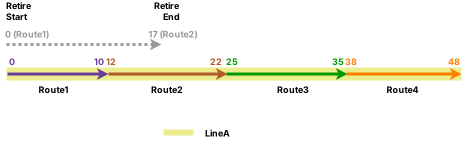
The following table provides details about the routes before the retirement:
| Route Name | Line Name | Line Order | From Date | To Date | From Measure | To Measure |
|---|---|---|---|---|---|---|
| Route1 | LineA | 100 | 1/1/2000 | <Null> | 0 | 10 |
| Route2 | LineA | 200 | 1/1/2000 | <Null> | 12 | 22 |
| Route3 | LineA | 300 | 1/1/2000 | <Null> | 25 | 35 |
| Route4 | LineA | 400 | 1/1/2000 | <Null> | 38 | 48 |
Routes after retirement
The following diagram shows the routes after the retirement:

The following table provides details about the routes after the retirement:
| Route Name | Line Name | Line Order | From Date | To Date | From Measure | To Measure |
|---|---|---|---|---|---|---|
| Route1 | LineA | 100 | 1/1/2000 | 1/1/2005 | 0 | 20 |
| Route2 | LineA | 200 | 1/1/2000 | 1/1/2005 | 12 | 22 |
| Route2 | LineA | 100 | 1/1/2005 | <Null> | 17 | 22 |
| Route3 | LineA | 300 | 1/1/2000 | 1/1/2005 | 25 | 35 |
| Route3 | LineA | 200 | 1/1/2005 | <Null> | 25 | 25 |
| Route4 | LineA | 400 | 1/1/2000 | 1/1/2005 | 38 | 48 |
| Route4 | LineA | 300 | 1/1/2005 | <Null> | 38 | 48 |

The following table provides details about the routes after the retirement:
| Route Name | Line Name | Line Order | From Date | To Date | From Measure | To Measure |
|---|---|---|---|---|---|---|
| Route1 | LineA | 100 | 1/1/2000 | 1/1/2005 | 0 | 20 |
| Route2 | LineA | 200 | 1/1/2000 | 1/1/2005 | 12 | 22 |
| Route2 | LineA | 100 | 1/1/2005 | <Null> | 12 | 17 |
| Route3 | LineA | 300 | 1/1/2000 | 1/1/2005 | 25 | 35 |
| Route3 | LineA | 200 | 1/1/2005 | <Null> | 25 | 25 |
| Route4 | LineA | 400 | 1/1/2000 | 1/1/2005 | 38 | 48 |
| Route4 | LineA | 300 | 1/1/2005 | <Null> | 38 | 48 |
Events before retirement
There are two spanning events on routes on Line A. The following diagram shows the routes and events before the retirement:

The following table provides details about the events before the retirement:
| Event ID | From Date | To Date | From Route Name | To Route Name | From Measure | To Measure |
|---|---|---|---|---|---|---|
| Event1 | 1/1/2000 | <Null> | Route1 | Route3 | 0 | 30 |
| Event2 | 1/1/2000 | <Null> | Route3 | Route4 | 30 | 48 |
The following sections describe how event behavior rules are enforced when routes on a line in a line network are retired.
Stay Put event behavior
Although the geographic location of the event is maintained, the measures can change. The event can also split if it crosses the retire region, and portions within the retirement region are retired.
The route retirement edit activity with the Stay Put event behavior has the following effects:
Event 1 is retired on the date of the retirement because part of it is in the edit section. A new event is created on the post-retirement routes with the retirement date as the starting date. The length of the new Event 1 is shorter because its start measure value changes to 17 on Route 2 and the end measure value changes to 30 on Route 3 to accommodate the new measures of Route 2.
Event 2 is not affected because it is not in the retirement region.
The following diagram shows the routes and events after the retirement:
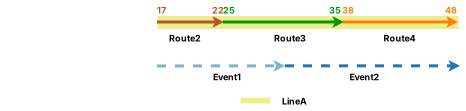
Note:
The retired event is not drawn in the previous diagram.
The following table provides details about the events after the retirement:
| Event ID | From Date | To Date | From Route Name | To Route Name | From Measure | To Measure | Location Error |
|---|---|---|---|---|---|---|---|
| Event1 | 1/1/2000 | 1/1/2005 | Route1 | Route3 | 0 | 30 | No Error |
| Event1 | 1/1/2005 | <Null> | Route2 | Route3 | 17 | 30 | No Error |
| Event2 | 1/1/2000 | <Null> | Route3 | Route4 | 30 | 48 | No Error |
The following table shows the edit activities involved in the route edit and their corresponding event behaviors:
| Edit activity | Event behavior |
|---|---|
| Retire | Stay Put |
| Calibrate | Stay Put |
The route retirement described above has the following effects:
Event 1 is retired on the date of the retirement because part of it is in the edit section. A new event is created on the post-retirement route with the retirement date as the starting date. The length of the new Event 1 is shorter because its start measure value changes to 12 on Route 2 and the end measure value changes to 30 on Route 3 to accommodate the new measures of Route 2.
Event 2 is not affected because it is not in the retirement region.
The following diagram shows the routes and events after the retirement:
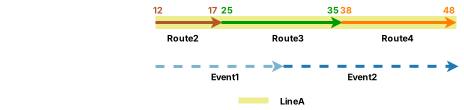
Note:
The retired event is not drawn in the previous diagram.
The following table provides details about the events after the retirement:
| Event ID | From Date | To Date | From Route Name | To Route Name | From Measure | To Measure | Location Error |
|---|---|---|---|---|---|---|---|
| Event1 | 1/1/2000 | 1/1/2005 | Route1 | Route3 | 0 | 30 | No Error |
| Event1 | 1/1/2005 | <Null> | Route2 | Route3 | 12 | 30 | No Error |
| Event2 | 1/1/2000 | <Null> | Route3 | Route4 | 30 | 48 | No Error |
Move event behavior
Although the measures of the event are maintained, the geographic location can change.
The route retirement edit activity with the Move event behavior has the following effects:
The following table shows the edit activities involved in the route edit and their corresponding event behaviors:
| Edit activity | Event behavior |
|---|---|
| Retire | Move |
| Calibrate | Stay Put |
The route retirement described above has the following effects:
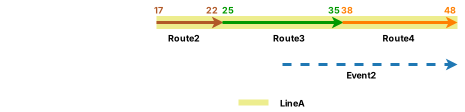
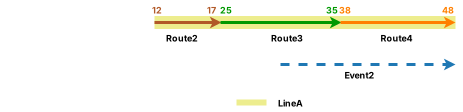
Event 1 is retired on the date of the retirement because part of it is in the edit section. A new event is created on the post-retirement route with the retirement date as the starting date. Because the measures do not change for the Move behavior, the new Event 1 gets a location error while trying to locate Route 1 for its start measure but Route 1 no longer exists. There is a record for the new Event 1 in the event table, but it is not drawn because it does not have a length due to the location error.
Event 2 is not affected because it is not in the retirement region.
The following diagram shows the routes and events after the retirement:
The following table provides details about the events after the retirement:
| Event ID | From Date | To Date | From Route Name | To Route Name | From Measure | To Measure | Location Error |
|---|---|---|---|---|---|---|---|
| Event1 | 1/1/2000 | 1/1/2005 | Route1 | Route3 | 0 | 30 | No Error |
| Event1 | 1/1/2005 | <Null> | Route1 | Route3 | 0 | 30 | Route Not Found |
| Event2 | 1/1/2000 | <Null> | Route3 | Route4 | 30 | 48 | No Error |
Retire event behavior
Events intersecting the retire region are retired.
The route retirement edit activity with the Retire event behavior has the following effects:
The following table shows the edit activities involved in the route edit and their corresponding event behaviors:
| Edit activity | Event behavior |
|---|---|
| Retire | Retire |
| Calibrate | Stay Put |
The route retirement described above has the following effects:
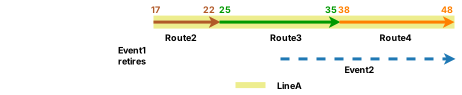
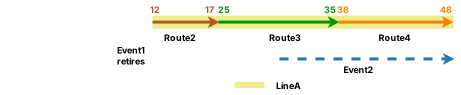
Event 1 retires on the date of the retirement because it intersects the retired region.
Event 2 is not affected because it is not in the retirement region.
The following diagram shows the routes and events after the retirement:
The following table provides details about the events after the retirement:
| Event ID | From Date | To Date | From Route Name | To Route Name | From Measure | To Measure | Location Error |
|---|---|---|---|---|---|---|---|
| Event1 | 1/1/2000 | 1/1/2005 | Route1 | Route3 | 0 | 30 | No Error |
| Event2 | 1/1/2000 | <Null> | Route3 | Route4 | 30 | 48 | No Error |
Snap event behavior
Although the geographic location of the event is maintained by snapping to the new route location of retirement, the measures can change. The event can also split if it crosses the retirement where concurrent routes exist.
In this example, there is a Route 5 that is concurrent with the routes on Line A. Route 5 is on Line B and is in the reversed direction. It has the start measure value of 0 and end measure value of 40.
The route retirement described above has the following effects:
Event 1 is retired on the date of retirement because part of it is in the edit section. It then splits into two event records on the post-retirement routes with the retirement date as the starting date. This is because a concurrent route exists in the retirement section, and the portion of Event 1 in the retirement section snaps to Route 5, the concurrent route, after retirement. This portion of Event 1 is also reversed to accommodate the direction of Route 5. As a result, Event 1 splits into two pieces to maintain its geographic location. The first event record has the start measure value of 16 on Route 2 and end measure value of 30 on Route 3. The second event record snaps to Route 5 and has the start measure value of 25 and end measure value of 40 on Route 5.
Event 2 is not affected because it is not in the retirement region.
The following diagram shows the route and events after the retirement:
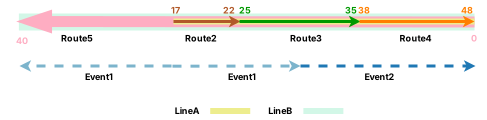
The following table provides details about the events after retirement:
| Event ID | From Date | To Date | From Route Name | To Route Name | From Measure | To Measure | Location Error |
|---|---|---|---|---|---|---|---|
| Event1 | 1/1/2000 | 1/1/2005 | Route1 | Route3 | 0 | 30 | No Error |
| Event1 | 1/1/2005 | <Null> | Route2 | Route3 | 17 | 30 | No Error |
| Event1 | 1/1/2005 | <Null> | Route5 | Route5 | 25 | 40 | No Error |
| Event2 | 1/1/2000 | <Null> | Route3 | Route4 | 30 | 48 | No Error |
The following table shows the edit activities involved in the route edit and their corresponding event behaviors:
| Edit activity | Event behavior |
|---|---|
| Retire | Snap |
| Calibrate | Stay Put |
The route retirement described above has the following effects:
Event 1 is retired on the date of retirement because part of it is in the edit section. It then splits into two event records on the post-retirement routes with the retirement date as the starting date. This is because a concurrent route exists in the retirement section, and the portion of Event 1 in the retirement section snaps to Route 5, the concurrent route, after retirement. This portion of Event 1 is also reversed to accommodate the direction of Route 5. As a result, Event 1 splits into two pieces to maintain its geographic location. The first event record has the start measure value of 12 on Route 2 and end measure value of 30 on Route 3 when the calibrate Stay Put behavior is applied. The second event record snaps to Route 5 and has the start measure value of 25 and end measure value of 40 on Route 5.
Event 2 is not affected because it is not in the retirement region.
The following diagram shows the route and events after the retirement:
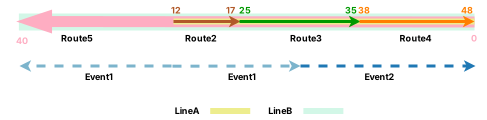
The following table provides details about the events after retirement:
| Event ID | From Date | To Date | From Route Name | To Route Name | From Measure | To Measure | Location Error |
|---|---|---|---|---|---|---|---|
| Event1 | 1/1/2000 | 1/1/2005 | Route1 | Route3 | 0 | 30 | No Error |
| Event1 | 1/1/2005 | <Null> | Route2 | Route3 | 12 | 30 | No Error |
| Event1 | 1/1/2005 | <Null> | Route5 | Route5 | 25 | 40 | No Error |
| Event2 | 1/1/2000 | <Null> | Route3 | Route4 | 30 | 48 | No Error |