Smooth Polygon (Cartography Tools)
Summary
Smooths sharp angles in polygon outlines to improve aesthetic or cartographic quality.
Learn more about how the Smooth Line and Smooth Polygon tools work
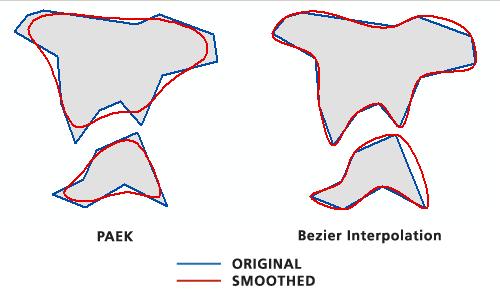
Illustration
Usage
The Smoothing Algorithm parameter has the following options:
Polynomial Approximation with Exponential Kernel (PAEK)—Smooths polygons based on a smoothing tolerance. Each smoothed polygon may have more vertices than its source polygon. The Smoothing Tolerance parameter controls the length of a moving path used in calculating the new vertices. The shorter the length, the more detail that will be preserved and the longer the processing time.
Bezier interpolation—Smooths polygons without using a tolerance by creating approximated Bezier curves to match the input polygons.
Use the Input Barrier Layers parameter to identify features that must not be crossed by smoothed polygons. Barrier features can be points, lines, or polygons.
Processing large datasets may exceed memory limitations. In such cases, consider processing input data by partition by identifying a relevant polygon feature class in the Cartographic Partitions environment setting. Portions of the data, defined by partition boundaries, will be processed sequentially. The resulting feature class will be seamless and consistent at partition edges. See Generalizing large datasets using partitions for more information.
Caution:
The Cartographic Partitions environment setting is ignored when the Handling Topological Errors parameter is set to Do not check for topological errors or Check and flag topological errors.
Domains and subtypes will be copied to the output even if the Transfer field domain, subtypes, and attributes rules environment is unchecked.
The output polygon feature class will be topologically correct. Any topological errors in the input data are flagged in the output polygon feature class. The output feature class will include the following additional fields:
InPoly_FID—Contains the feature IDs of the input.SmoPgnFlag—Contains the topological errors of the input. A value of 1 indicates that a topological error is present; a value of 0 (zero) indicates that no errors are present.
Legacy:
Prior to the ArcGIS Pro 2.2 version of this tool, the Preserve endpoint for rings parameter was used to specify whether the endpoint of a resulting isolated polygon ring would be preserved. This parameter is still included in the tool's syntax for compatibility in scripts and models but is now ignored and hidden on the tool's dialog box.
Parameters
| Label | Explanation | Data type |
|---|---|---|
|
Input Features |
The polygon features that will be smoothed. |
Feature Layer |
|
Output Feature Class |
The output polygon feature class that will be created. |
Feature Class |
|
Smoothing Algorithm |
Specifies the smoothing algorithm that will be used.
|
String |
|
Smoothing Tolerance |
The tolerance used by the Smoothing Algorithm parameter's Polynomial Approximation with Exponential Kernel (PAEK) option. A tolerance must be specified, and it must be greater than zero. You can choose a preferred unit; the default is the feature unit. This parameter is unavailable when the Bezier interpolation option is used for the Smoothing Algorithm parameter. |
Linear Unit |
|
Preserve endpoint for rings (Optional) |
This is a legacy parameter that is no longer used. It was formerly used to specify whether the endpoint of an isolated polygon ring would be preserved. This parameter is still included in the tool's syntax for compatibility in scripts and models. Specifies whether the endpoints of isolated polygon rings will be preserved. This option works with the
|
Boolean |
|
Handling Topological Errors (Optional) |
Specifies how topological errors (possibly introduced in the process, such as line crossing or overlapping) will be handled.
|
String |
|
Input Barrier Layers (Optional) |
The inputs containing features that will act as barriers for smoothing. The resulting smoothed polygons will not touch or cross barrier features. |
Feature Layer |
Environments
Current Workspace, Default Output Z Value, Output M Domain, Output XY Domain, Output Coordinate System, Extent, Output has M values, Output has Z values, Scratch Workspace, XY Tolerance, Cartographic Partitions
Licensing information
- Basic: No
- Standard: Yes
- Advanced: Yes